


UK CBAM Carbon Price Relief 2027: How Importers Can Maximise and Defend Their Liability Reduction

Updated: Sep 23
Carbon Price Relief Under UK CBAM: An Importer's Implementation and Liability-Optimisation Framework for 2027
Published by Sekason Research Limited, London | September 2026
A CBAM Journal Executive Intelligence Report

Legal Disclaimer and Scope
This report is published by Sekason Research Limited, a United Kingdom-based independent research intelligence company registered in England and Wales.
The content of this report is provided for informational and research intelligence purposes only. It does not constitute legal advice, tax advice, financial advice, or regulatory compliance advice of any kind. Readers should not act or refrain from acting on the basis of any information contained in this report without first obtaining independent professional advice from a qualified legal, tax, or compliance adviser with expertise in the relevant jurisdiction.
Sekason Research Limited is not a law firm, tax adviser, accountancy firm, or regulated financial adviser. Nothing in this report establishes or should be construed as establishing a professional advisory relationship between Sekason Research Limited and the reader.
Read the full disclimer here; https://www.cbamjournal.com/disclaimer
Scope:
This report addresses the UK Carbon Border Adjustment Mechanism Carbon Price Relief framework as established under Finance Act 2026, Part 5, and the statutory instruments made thereunder, including SI 2026/809, SI 2026/802, and SI 2026/995. It reflects information available as at the date of publication. UK CBAM legislation, HMRC guidance, qualifying scheme lists, and prescribed carbon price rates are subject to change. Readers are responsible for verifying the currency and applicability of all regulatory references before relying on them.
This report does not address the legal or tax position of any specific importer, transaction, supply chain, or business. Sector and scenario data are illustrative only and do not represent a projection, forecast, or assessment of any individual organisation's liability.
Whilst Sekason Research Limited has taken reasonable care to ensure the accuracy of information in this report, no representation or warranty, express or implied, is made as to its completeness, accuracy, or fitness for any particular purpose. Sekason Research Limited accepts no liability for any loss or damage arising directly or indirectly from reliance on this report.
© 2026 Sekason Research Limited. All rights reserved. No part of this report may be reproduced, distributed, or transmitted in any form without the prior written permission of Sekason Research Limited.
1. Executive Summary
HMRC published its provisional list of qualifying overseas carbon-pricing schemes on 27 August 2026, naming sixteen qualifying schemes — among them the EU ETS, China ETS, India's Carbon Credit Trading Scheme (CCTS), Japan's GX-ETS and Korea's ETS — yet most importers have no mechanism for converting that list into a defensible, calculation-ready evidence trail before UK CBAM Carbon Price Relief becomes operative on 1 January 2027. Under SI 2026/809 — nine regulations governing eligibility, verification, effective-price calculation, currency conversion, and six-year record-keeping — CPR is not automatic: the importer must establish scheme eligibility, obtain an independently verified carbon-pricing verification form, compute the effective carbon price after deducting free allowances, rebates and compensation, and convert any non-GBP price into sterling using HMRC's prescribed quarterly exchange rate. The EU CBAM certificate price for Q2 2026 stood at €75.28/tCO₂ — a structural indicator of the financial scale of what CPR can offset, or forfeit, per tonne of qualifying imports.
This report is the implementation resource HMRC guidance does not provide. It translates SI 2026/809 into a CPR maximisation framework covering every confirmed qualifying scheme, the supplier evidence acquisition process, multi-jurisdiction and precursor-emissions calculations, currency conversion mechanics, and a sector-by-sector action matrix across the five UK CBAM sectors. It is written for the Compliance Manager who must operationalise CPR across a real supply base — potentially spanning five or more jurisdictions — before the first 2027 import declaration is filed.
HMRC's published guidance sets out the legal obligations. This report operationalises them — specifying what evidence to collect, from whom, in what sequence, before the first 2027 import.
2. Regulatory Context
The legal foundation for UK CBAM Carbon Price Relief comprises Finance Act 2026, Part 5, which creates the CBAM liability, and SI 2026/809 — made on 13 July 2026 — which establishes the complete CPR mechanism. The Carbon Border Adjustment Mechanism (Emissions and Verification) Regulations 2026 (SI 2026/995) followed on 9 September 2026, completing the primary UK CPR legal framework within ten weeks of HMRC's first CPR guidance publication.
EU CBAM operates under a parallel but structurally distinct framework: Regulation (EU) 2023/956, Article 9, provides a deduction mechanism for carbon price effectively paid in a third country. The two regimes share a policy objective — ensuring imported goods face a comparable carbon price to domestically produced equivalents — but differ in timeline, evidence standard, calculation methodology, and sector scope. Managing them as a single compliance exercise is an error with material financial consequences.
2.1 Finance Act 2026 and SI 2026/809: The Legal Mechanism
FINDING: SI 2026/809 Regulation 15 requires all CPR evidence and calculations to be retained for six years from the date of each import, under an instrument made on 13 July 2026.
SO WHAT: An importer who cannot reconstruct the complete evidence trail — scheme eligibility, verification form, effective-price calculation, currency conversion — for any 2027 import has no defence on HMRC review, regardless of how much carbon price the overseas installation actually paid.
NOW WHAT: Establish a document-retention protocol indexed to import date before the first 2027 import — the six-year clock starts with each individual import, not with the annual CBAM return.
The CPR mechanism in SI 2026/809 runs through nine specific regulations, each representing a distinct compliance obligation.
Regulation 5 sets eligibility.
Regulation 6 defines a qualifying carbon-pricing scheme.
Regulations 9 and 10 establish verification requirements.
Regulation 11 addresses rebates, refunds and free allowances.
Regulation 12 defines the effective carbon price calculation.
Regulation 13 sets the CPR formula and cap.
Regulation 14 governs currency conversion.
Regulation 15 mandates six-year record-keeping.
An importer who satisfies Regulations 5 and 6 but fails Regulation 9 loses CPR in its entirety — not reduced, eliminated.
CPR Obligation | Instrument | Requirement |
CBAM liability | Finance Act 2026, Part 5 | UK CBAM applies to specified goods from 1 January 2027 |
Registration | SI 2026/802 | Importers meeting £50,000 threshold must register |
CPR eligibility | SI 2026/809, Reg 5 | Installation must participate in qualifying scheme; verification requirements satisfied |
Qualifying scheme | SI 2026/809, Reg 6 | Four criteria: government administration, participation, carbon cost, public information |
Verification | SI 2026/809, Regs 9–10 | Completed, independently verified carbon-pricing verification form required |
Effective carbon price | SI 2026/809, Reg 12 | Calculated after accounting for relevant pricing elements and monetary support |
CPR calculation | SI 2026/809, Reg 13 | Effective carbon price × embodied emissions, capped at CBAM liability |
Currency conversion | SI 2026/809, Reg 14 | Foreign-currency CPR converted via HMRC's prescribed quarterly exchange rate |
Record-keeping | SI 2026/809, Reg 15 | Evidence retained for six years |
2.2 UK CPR vs EU Article 9: Why They Cannot Be Managed as One
FINDING: UK CBAM's first return and payment falls on 31 May 2028, covering 2027 imports; EU CBAM's first certificate surrender falls on 30 September 2027, covering 2026 imports — the two first financial deadlines sit eight months apart and apply to different accounting periods.
SO WHAT: A dual-jurisdiction exporter — an Indian steel producer shipping to both the EU and UK — must maintain two separate evidence streams under two structurally different legal frameworks simultaneously, from 1 January 2026 (EU) and 1 January 2027 (UK), with different calculation methodologies, different verification standards, and different currency-conversion rules.
NOW WHAT: Begin supplier conversations about parallel evidence obligations under both regimes before 31 October 2026 — early enough for suppliers to engage appropriate verifiers and establish separate EU and UK documentation streams before the first 2027 UK CBAM import.
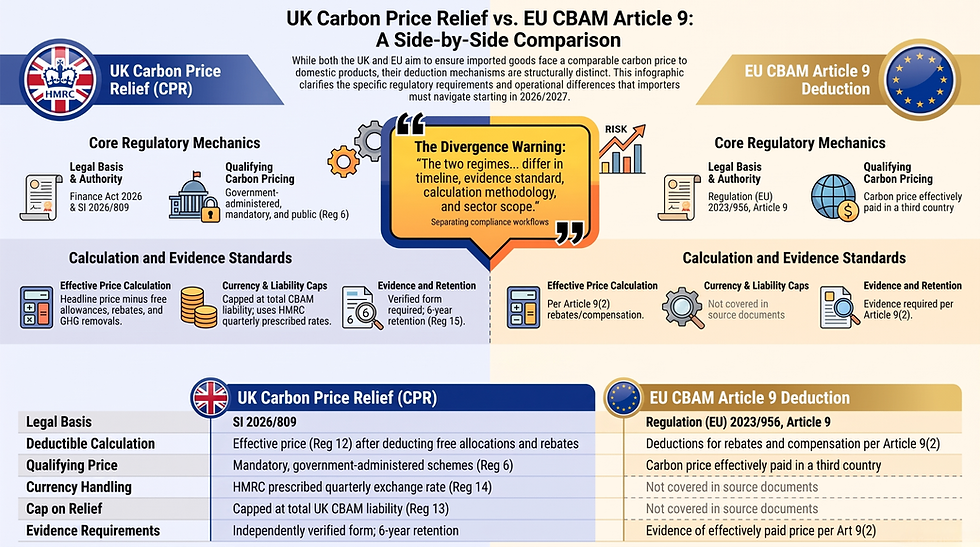
Feature | UK CPR | EU Article 9 Deduction |
Legal basis | SI 2026/809 | Regulation (EU) 2023/956, Article 9 |
Who claims it | Liable person (importer) | Authorised CBAM declarant |
Effective regime start | 1 January 2027 | 1 January 2026 |
First financial deadline | 31 May 2028 (2027 imports) | 30 September 2027 (2026 imports) |
Sector scope | 5 sectors (no electricity) | 6 sectors (includes electricity) |
Free-allocation treatment | Deducted per Reg 11 | Rebates/compensation per Art 9(2) |
Record-keeping | 6 years (Reg 15) | Evidence per Article 9(2) |
3. CPR Eligibility: Who Can Claim and When
Eligibility is the first gate. Many importers will assume they qualify because their supplier operates in a country with a carbon price. That assumption fails in two common ways: the installation itself — not the country — must participate in the qualifying scheme, and the importer — not the installation — bears the entire burden of proving it does.
3.1 The Four Eligibility Conditions Under Regulation 5
FINDING: SI 2026/809 Regulation 5 places CPR eligibility responsibility entirely on the liable person (importer) — not the overseas installation, not the exporter — under an instrument made on 13 July 2026.
SO WHAT: If an overseas installation provides incorrect, incomplete, or unverifiable carbon-pricing data, the importer carries the full compliance risk with no regulatory mechanism to pass that risk back to the supplier.
NOW WHAT: Insert contractual CPR evidence clauses — including data-accuracy warranties and financial penalties for non-provision — into all CBAM-category supplier agreements before Q1 2027 imports begin.
Four conditions must be satisfied simultaneously for CPR to be claimable.
The importer is the liable person.
The installation producing or processing the imported good must participate in a qualifying carbon-pricing scheme as defined under Regulation 6.
The good must fall within UK CBAM scope.
The verification requirements under Regulations 9 and 10 must be fully met.
Failure on any single condition eliminates CPR on that import entirely.
3.2 The Registration Threshold and CPR Interaction
FINDING: UK CBAM registration is triggered at £50,000 of CBAM goods, assessed under two separate concurrent tests: a forward-looking 30-day test and a backward-looking 12-month test, under Finance Act 2026, Schedule 16/17 and SI 2026/802.
SO WHAT: A company that crosses the registration threshold unexpectedly mid-2027 faces retroactive registration and CPR evidence obligations for prior 2027 imports it has not yet documented — with no provision in the regulations for retrospective evidence collection.
NOW WHAT: Any importer whose CBAM-category imports are approaching the £50,000 registration threshold must treat registration as imminent and begin CPR evidence collection immediately — not after the threshold is formally crossed.
Both tests run concurrently. An importer expecting to import £45,000 of CBAM-category goods over the next 30 days is caught by the forward-looking test even if the prior 12 months were below threshold. Monitoring only one test is insufficient.
3.3 Precursor Emissions and Multi-Stage Supply Chains
FINDING: HMRC's CPR guidance published on 16 July 2026 expressly permits CPR on goods where precursor emissions are subject to a separate qualifying carbon-pricing scheme — meaning multi-stage supply chains can generate relief at each qualifying stage, provided a separate Regulation 12 calculation is completed per stage.
SO WHAT: A UK importer of finished steel using Indian ore processed in an EU mill may have two distinct CPR streams — India CCTS at the precursor stage and EU ETS at the direct production stage — each requiring a separate evidence chain and a separate Regulation 12 calculation.
NOW WHAT: Map each imported good's full production chain to identify precursor carbon-price exposure before the first 2027 import, treating supply-chain intelligence as a pre-import task, not a post-filing review exercise.
Research Boundary
HMRC's 16 July 2026 guidance confirms precursor emissions are within scope of CPR but does not provide a worked multi-stage calculation scenario. The two-stream example above is illustrative of the mechanism, not a confirmed HMRC-endorsed methodology. Importers with complex precursor supply chains should seek direct HMRC clarification before the first 2027 import.
4. Qualifying Carbon-Pricing Schemes
HMRC's qualifying-scheme list is the starting point for every CPR decision. Without scheme eligibility, no calculation proceeds, no relief is claimable, and no evidence collection is worth beginning.
4.1 The Four Criteria a Scheme Must Meet
FINDING: HMRC published its provisional list of qualifying overseas carbon-pricing schemes on 27 August 2026 — the list is expressly provisional and non-exhaustive, meaning schemes can be added or removed at any point without a fixed review cycle.
SO WHAT: An importer whose supplier operates under a scheme qualifying today cannot guarantee that scheme will remain qualifying at the point of import or at the date the CBAM return is filed in May 2028.
NOW WHAT: Check HMRC's qualifying-scheme list within 30 days of each import, retain a dated copy confirming status at the time of evidence collection, and build scheme-monitoring into the quarterly compliance calendar from Q1 2027.
A scheme qualifies under SI 2026/809 Regulation 6 if it meets four criteria:
it is administered by a government body;
participation is mandatory for covered installations;
it imposes a carbon cost on covered emissions;
and information about the scheme is publicly available.
A voluntary or industry-level carbon pricing arrangement does not qualify. A government-administered tax on carbon with public documentation does. The distinction matters most for emerging schemes in developing markets.
4.2 Confirmed Qualifying Schemes: Analysis of the Top Five
FINDING: HMRC's 27 August 2026 provisional list confirms eight named qualifying schemes, including the EU ETS, China ETS, India Carbon Credit Trading Scheme, Japan GX-ETS, Korea ETS, Australia Safeguard Mechanism, Singapore Carbon Tax and South Africa Carbon Tax.
SO WHAT: Each confirmed scheme has materially different free-allocation ratios, carbon-price levels, and verification infrastructure — CPR value and evidence burden vary substantially by source country, meaning a uniform CPR approach across a multi-origin supply base will systematically overstate relief for some imports and miss it entirely for others.
NOW WHAT: Prioritise CPR evidence collection from the scheme with the highest carbon price and lowest free-allocation ratio in your supply chain by 31 October 2026 — starting with EU ETS and Korea ETS given their more established carbon-price structures.
Scheme | Jurisdiction | Free Allocation? | Key CPR Risk | Evidence Complexity |
EU ETS | European Union | Yes — significant for steel and aluminium | Overstatement if free allocation not deducted per Reg 11 | High: multiple evidence streams required |
China ETS | China | Yes — benchmark-based | Allocation methodology transparency at installation level | Medium-High: scheme data may not be publicly disclosed |
India CCTS | India | Limited / evolving | Scheme maturity; verification infrastructure still developing | High: limited verifier precedent |
Japan GX-ETS | Japan | Yes | Verification evidence standards | Medium |
Korea ETS | Korea | Yes | Allocation documentation | Medium |
Research Boundary
HMRC's provisional list of 27 August 2026 contains sixteen qualifying schemes. Eight are confirmed by name in this report. The remaining eight have not been individually identified in available source material. The analysis above covers confirmed schemes only.
4.3 Schemes Not Currently on the Qualifying List
FINDING: HMRC's provisional list published on 27 August 2026 covers sixteen qualifying schemes — importers sourcing from countries whose carbon-pricing mechanisms are not on the list cannot claim CPR, regardless of the actual carbon cost the installation bears.
SO WHAT: An importer sourcing from a market with an unrecognised or emerging carbon-pricing mechanism — Vietnam, Indonesia, Thailand — bears 100% of UK CBAM liability on those goods from 1 January 2027, with no offsetting relief available under the current published list.
NOW WHAT: Flag all non-qualifying supply origins for commercial re-evaluation before Q4 2026 sourcing negotiations, calculating the unrelieved CBAM liability as a direct input into supply-chain pricing decisions.
HMRC has confirmed the list is non-exhaustive, meaning a scheme not currently listed may qualify in future if it meets the Regulation 6 criteria. The path to recognition is not defined in SI 2026/809 or in HMRC's current guidance. Importers who need a scheme added should engage through relevant industry or trade associations. Until a scheme is formally listed, no CPR is available.
5. Calculating the Effective Carbon Price
The effective carbon price is the operational heart of CPR. Getting it wrong — by omitting required deductions or including deductions that are not permitted — produces a CPR figure HMRC can reject. The calculation sequence is prescribed by statute. Follow it in order.
5.1 The HMRC Calculation Sequence Under Regulation 12
FINDING: SI 2026/809 Regulation 11 requires relevant rebates, refunds and qualifying greenhouse-gas-removal payments to be deducted before the effective carbon price is finalised — and free or zero-priced emissions generate no CPR under any circumstances, confirmed in HMRC's guidance published on 16 July 2026.
SO WHAT: An overseas installation with 30% free allocation on its covered emissions immediately reduces the CPR available by that proportion, regardless of the headline carbon price paid on the remaining 70% — a reduction that cannot be recovered through any other calculation adjustment.
NOW WHAT: Require the overseas installation to disclose its free-allocation ratio, rebate arrangements, and compensation mechanisms as mandatory data fields on the carbon-pricing verification form, for any import after 1 January 2027.

Step | Operation | Evidence Required |
1 | Start with headline carbon price paid | Price certificate, installation evidence |
2 | Identify qualifying emissions subject to that price | Verified emissions data per unit of product |
3 | Deduct free/zero-priced emissions | Free-allocation disclosure from installation |
4 | Deduct relevant rebates and refunds | Rebate documentation |
5 | Deduct qualifying greenhouse-gas-removal payments | Removal payment records |
6 | = Effective carbon price | All above verified and documented |
7 | Multiply by embodied emissions subject to qualifying price | Verified embedded-emissions figure |
8 | Apply CPR cap (cannot exceed UK CBAM liability) | UK CBAM liability calculation for the import |
9 | = CPR claimable on that import | Complete, six-year-retainable evidence file |
5.2 Treatment of Free Allowances: The Most Commercially Significant Variable
FINDING: HMRC's CPR guidance published on 16 July 2026 confirms that free or zero-priced emissions generate no Carbon Price Relief — at the EU ETS Q2 2026 certificate price of €75.28/tCO₂, an installation with 30% free allocation immediately reduces available CPR by that proportion, regardless of the headline carbon price paid on the remaining 70%.
SO WHAT: An EU steel producer receiving substantial free allocations under the EU ETS will generate materially less CPR than the €75.28/tCO₂ Q2 2026 certificate price would suggest — an importer who omits this deduction overstates their CPR claim and faces correction on HMRC review.
NOW WHAT: Make free-allocation disclosure a mandatory data field on the carbon-pricing verification form issued to all qualifying-scheme suppliers, and issue those forms before 31 October 2026 for Q1 2027 imports.
Free allocation is not a marginal issue. Under the EU ETS, steel and aluminium producers receive free allocations calibrated to product benchmarks. Under China's ETS, allocation ratios are determined by sector and intensity benchmarks that may not be publicly disclosed at installation level. Under India's CCTS — a newer and still-maturing scheme — allocation methodologies are not yet fully standardised. In each case, the importer must obtain the specific allocation figure for the specific installation. Sector averages are not sufficient and will not withstand HMRC review.
5.3 Rebates, Compensation and State Aid: The Hidden CPR Reducers
FINDING: SI 2026/809 Regulation 11 explicitly requires relevant rebates, refunds and compensation — including state compensation for indirect carbon costs — to reduce the effective carbon price before CPR is calculated, under an instrument made on 13 July 2026.
SO WHAT: An EU steel or aluminium producer receiving both EU ETS free allowances and national indirect-cost compensation — a common arrangement under EU state-aid frameworks for energy-intensive industries — may generate far less CPR than either the headline ETS price or the free-allocation calculation alone implies.
NOW WHAT: Include a specific disclosure request for state compensation, energy-cost rebates and indirect-cost compensation as a named line item in the verification form template issued to all EU-based suppliers before 30 November 2026.
This is the compliance obligation most frequently omitted from public guidance on UK CPR. HMRC's formula requires these deductions. HMRC's own worked example demonstrates the calculation sequence. Yet professional guidance rarely explains how to collect the data from a supplier who does not routinely disclose compensation arrangements. The answer is contractual: require it before the supply relationship is relied upon for CPR.
5.4 Multiple Carbon Prices on the Same Good
FINDING: HMRC's CPR guidance published on 16 July 2026 permits CPR at each qualifying production stage — a multi-stage supply chain spanning two of the sixteen confirmed qualifying schemes generates two separate Regulation 12 calculations and two Regulation 14 currency conversions.
SO WHAT: A multi-jurisdiction supply chain can generate CPR at each qualifying stage, but requires a separate Regulation 12 calculation and a separate Regulation 14 currency conversion for each stage — multiplying the compliance burden in proportion to the number of qualifying stages.
NOW WHAT: Build a per-stage CPR tracker for each imported good with identified multi-stage production before the first 2027 import where precursor carbon-price exposure is confirmed in the supply-chain map.
6. CPR Calculation and Currency Conversion
Regulation 12 produces the effective carbon price; Regulation 13 applies the CPR cap; Regulation 14 converts any non-GBP amount into sterling. Each step produces a result that differs materially from what an importer working from the headline carbon price alone would calculate — and each step has prescribed rules that must be followed in sequence.
6.1 The CPR Calculation Formula: Regulation 13 and the Liability Cap
FINDING: SI 2026/809 Regulation 13, made on 13 July 2026, caps CPR at the total UK CBAM liability on the imported good — at the EU ETS Q2 2026 reference price of €75.28/tCO₂, an EU steel importer with zero free allocation and fully verified emissions could eliminate UK CBAM liability entirely on those goods if the effective carbon price meets or exceeds the UK CBAM rate when confirmed by HMRC in Autumn 2026.
SO WHAT: An importer sourcing from a high-carbon-price jurisdiction — such as the EU ETS, where the Q2 2026 certificate price was €75.28/tCO₂ — may eliminate UK CBAM liability entirely on those goods if the effective carbon price meets or exceeds the UK CBAM rate, but only where the complete Regulation 12 calculation sequence has been executed with fully verified data.
NOW WHAT: Model best-case and worst-case CPR scenarios for each supply origin using the Regulation 13 formula before finalising 2027 sourcing contracts — complete scenario modelling by 31 December 2026 so CPR value informs commercial negotiations, not post-contract calculation.
6.2 Currency Conversion: HMRC's Quarterly Rate Mechanism
FINDING: SI 2026/809 Regulation 14, made on 13 July 2026, requires non-GBP CPR to be converted using HMRC's prescribed quarterly exchange rate — meaning imports across the five confirmed qualifying-scheme currencies (EUR, CNY, INR, JPY, KRW) each require a separate prescribed rate, not a spot rate or annual average.
SO WHAT: An importer who plans CPR calculations using current spot rates will produce a different — and potentially incorrect — sterling figure for each quarterly import batch, since the prescribed rate is retrospective and changes each quarter independently of market movement.
6.3 Multi-Currency Scenarios: The Quarterly Rate in Practice
FINDING: SI 2026/809 Regulation 14 requires each quarterly import batch to apply HMRC's prescribed rate for the preceding quarter — for Q1 2027 imports across the five confirmed qualifying-scheme currencies, the applicable rates are the Q4 2026 prescribed rates, published by HMRC before 1 January 2027.
SO WHAT: A single annual GBP/INR assumption applied across all 2027 imports will produce systematically incorrect CPR calculations — a structural error that compounds with import frequency and may produce a material aggregate discrepancy across the annual CBAM return filed in May 2028.
NOW WHAT: Build a currency conversion log indexed to import date — recording the HMRC prescribed quarterly rate applied and its source document — before the first 2027 import, and update it at the start of each quarter.
Import Origin | Currency | Rate Basis Under Reg 14 | Quarter Applied (Q1 2027 imports) |
India (CCTS) | INR | Quarter preceding import | Q4 2026 rate |
China (ETS) | CNY | Quarter preceding import | Q4 2026 rate |
Japan (GX-ETS) | JPY | Quarter preceding import | Q4 2026 rate |
Korea (ETS) | KRW | Quarter preceding import | Q4 2026 rate |
EU (ETS) | EUR | Quarter preceding import | Q4 2026 rate |
7. Verification Requirements
Verification is not optional and cannot be completed retrospectively. The carbon-pricing verification form must be in hand before CPR is calculated. A completed but non-compliant form — signed by an unqualified verifier, or missing required data fields — has the same effect as no form: CPR is forfeited in full.
7.1 The Carbon-Pricing Verification Form: What Is Required
FINDING: SI 2026/809 Regulations 9–10 require the importer to obtain a completed carbon-pricing verification form, independently verified to specified standards — this is a legal prerequisite for any CPR claim, confirmed in HMRC's guidance published on 16 July 2026. Note: the statutory deadline for obtaining the verification form under Regulation 10 is before the CBAM return submission (31 May 2028), not the import date — however contemporaneous collection per import is the recommended and most defensible approach.
SO WHAT: Without a compliant verification form, no CPR can be claimed regardless of the actual carbon price paid by the overseas installation — the evidence requirement is not procedural formality, it is the legal mechanism that activates relief.
NOW WHAT: Issue formal requests for carbon-pricing verification forms to all qualifying-scheme suppliers by 31 October 2026 — sufficient lead time for the installation's verifier to complete the process before Q1 2027 imports.
The form must contain: confirmation that the specific installation participates in a qualifying scheme; the carbon price paid per unit of covered emissions; the free-allocation ratio; any rebates or compensation received; and independently verified embedded-emissions data for the goods in question. HMRC's guidance published on 16 July 2026 specifies these information categories. The form requires completion by an independent accredited verifier — self-certification by the installation or supplier is not sufficient and will not support a CPR claim.
7.2 Verifier Standards and Accreditation
FINDING: The European Commission published guidance on CBAM verification and accreditation for verifiers and National Accreditation Bodies on 24 August 2026 — UK CPR has equivalent independent verification requirements under SI 2026/809 Regulations 9–10.
SO WHAT: An unaccredited or unqualified verifier renders the verification form non-compliant and the CPR claim invalid — the importer, not the verifier, bears the financial consequence of that disqualification on HMRC review.
NOW WHAT: Require suppliers to confirm their verifier's accreditation credentials before a verification form is commissioned, for all imports from Q1 2027 onward.
Research Boundary
The precise UK verifier accreditation standard under SI 2026/809 Regulations 9–10 is not fully specified in HMRC guidance available at the report date. The EU Commission's 24 August 2026 verification guidance provides a parallel reference framework only. Importers must confirm UK-specific verifier qualification requirements with HMRC before engaging verifiers for 2027 imports.
7.3 If the Supplier Refuses or Cannot Provide the Form
FINDING: SI 2026/809 places the entire CPR evidence burden on the liable person — under Regulation 15, a missing or defective verification form creates a six-year evidence gap that cannot be remedied retrospectively, under an instrument made on 13 July 2026.
SO WHAT: A UK importer whose primary steel supplier refuses to provide a compliant verification form bears 100% of UK CBAM liability on those goods from 1 January 2027 — CPR is forfeited in entirety, not reduced.
NOW WHAT: Insert a contractual clause requiring provision of carbon-pricing verification data — with a financial penalty for non-provision or late provision — into all CBAM-category supplier agreements before Q1 2027 imports begin.
Three options exist when a supplier cannot or will not provide the form. Renegotiate the supply contract to make evidence provision a condition of trade. Identify an alternative qualifying supplier where CPR evidence is obtainable. Or price the unrelieved CBAM liability into commercial terms and accept no CPR on those goods. The third option is the simplest to execute and the most expensive to carry over a full year of imports.
8. Supplier Evidence Playbook
Collecting the right evidence from the right people at the right time is where most CPR claims will succeed or fail. HMRC's requirements are clear. The operational gap is the distance between what the regulations require and what a supplier's commercial team routinely produces. Close that gap before importing.
8.1 What to Request from Each Supplier
FINDING: HMRC's CPR guidance published on 16 July 2026 requires evidence across five categories — scheme eligibility, carbon price paid, free-allocation ratio, rebate/compensation disclosures, and independently verified emissions data — all before a CPR claim can be calculated.
SO WHAT: A supplier engagement that obtains only the headline carbon price but not the free-allocation ratio and rebate disclosures produces a CPR calculation HMRC can reject in full, even where the headline figure is accurate.
NOW WHAT: Issue the complete supplier evidence request document — using the checklist below — to all qualifying-scheme suppliers by 31 October 2026.
Evidence Element | Regulatory Basis | What to Request |
Scheme participation | SI 2026/809, Reg 5 | Confirmation the specific installation is a registered participant in the named qualifying scheme |
Carbon price paid | SI 2026/809, Reg 12 | Price per unit of covered emissions for the relevant production period |
Free-allocation ratio | SI 2026/809, Reg 11 | Number of free allowances allocated; proportion of total covered emissions |
Rebates and compensation | SI 2026/809, Reg 11 | Any rebates, refunds or state compensation received in the relevant period |
Verified embedded emissions | SI 2026/809, Regs 9–10 | Independently verified emissions per unit of product for the specific goods |
Completed verification form | SI 2026/809, Regs 9–10 | Signed by an independently accredited verifier |
Verifier accreditation | SI 2026/809, Regs 9–10 | Verifier's accreditation certificate and qualification details |
8.2 Who Inside the Supplier Provides Each Data Element
Note: No Step 2 regulatory data point maps to internal supplier contact structure. The following is operational guidance derived from the structure of SI 2026/809 Regulations 9–10 and the evidence categories HMRC requires. The FINDING / SO WHAT / NOW WHAT block is suppressed for this subsection per the writing brief instruction.
Carbon price data and rebate/compensation disclosures are typically held by the supplier's finance or treasury function. Verified emissions data and free-allocation ratios are typically held by the environmental or operations team. The verification form must be completed by the installation's appointed independent accredited verifier — an external party, not an employee of the supplier.
A single-contact email to a supplier's commercial team will not obtain all three data streams. Map the internal supplier contact structure for each qualifying-scheme installation before issuing evidence requests. Build a multi-contact engagement strategy — finance, environmental, and the named verifier — into the supplier evidence plan.
8.3 Red Flags and Escalation Triggers
FINDING: SI 2026/809 Regulation 15 requires retention of CPR evidence for six years — defects in supplier evidence cannot be remedied after the CBAM return is filed if the original documents are no longer obtainable.
SO WHAT: An importer who accepts a partially compliant verification form, calculates CPR on that basis, and files the return may face full CPR disallowance on HMRC review with no ability to remedy the defect after the fact.
NOW WHAT: Establish a formal pre-import CPR evidence review checkpoint — any red flag identified below must pause the CPR calculation or trigger a reduced claim before the import proceeds.
Five red flags requiring immediate escalation before proceeding: The verification form is completed or co-signed by the supplier's own employee rather than an independent accredited verifier. The free-allocation figure is absent, estimated, or marked as not applicable without written explanation. The scheme participation confirmation names a different installation than the one producing the specific imported goods. The carbon price disclosed covers a different period than the one in which the goods were produced. The rebate and compensation section of the verification form is blank with no accompanying explanation.
8.4 Supplier Contract Clauses for CPR Evidence Provision
FINDING: HMRC places the CPR evidence obligation entirely on the liable person (importer) under SI 2026/809 — confirmed in the instrument made on 13 July 2026 — with no regulatory mechanism to compel an overseas installation to provide verification data.
SO WHAT: Without contractual protection, a supplier's failure to provide a compliant verification form costs the importer their full CPR entitlement — a potentially material financial offset eliminated — with no remedy against the supplier.
NOW WHAT: Have legal counsel review and finalise CPR evidence clauses for all CBAM-category supplier contracts before 31 December 2026.
Three contract provisions are required.
First, an obligation clause: the supplier must provide a completed, independently verified carbon-pricing verification form — covering the specific installation and goods in question — within an agreed number of days of each shipment date.
Second, a penalty clause: failure to provide a compliant form by the agreed deadline triggers a financial penalty equivalent to the CPR foregone on that shipment, calculated using HMRC's prescribed formula.
Third, a data-accuracy warranty: the supplier warrants the accuracy of all carbon-price, free-allocation, and rebate/compensation disclosures and indemnifies the importer for any HMRC CPR correction arising from inaccurate data. These provisions require adaptation to governing law by qualified legal counsel.
9. Sector-Specific CPR Impact Analysis
CPR rules apply uniformly across all five UK CBAM sectors. CPR value does not. The combination of carbon-price level, free-allocation profile, scheme maturity, and verification infrastructure differs substantially between steel, aluminium, cement, fertilisers, and hydrogen.

9.1 Iron and Steel: The Highest-Volume UK CBAM Exposure
FINDING: India's Ministry of Steel reported finished-steel exports to the EU of 4.03 Mt (₹29,534 crore) in FY2023–24 — the largest authoritative single-country/sector dataset available for CBAM-exposed steel import volume.
SO WHAT: Indian steel represents a substantial share of UK CBAM-exposed steel imports; whether importers can capture CPR under India's CCTS will directly determine their cost position relative to EU or Korean steel, where CPR under more established schemes may deliver greater or more easily evidenced relief.
NOW WHAT: Steel importers sourcing from India must begin CCTS eligibility assessment and supplier verification form requests before 31 October 2026 to ensure Q1 2027 import readiness.
JSW Steel's management noted in the Q3 FY26 earnings call (February 2026) that its European exports were approximately 1.2–1.3 million tonnes, while Arun Maheshwari of JSW observed that
"the overall real-time impact assessment is still yet to come out because it is still very new."
Tata Steel's FY2025–26 integrated report identifies EU CBAM as a regulatory and market risk and states that its European businesses are developing green-steel strategies aligned with CBAM requirements. Tata Steel's group production was 31.67 Mt with a consolidated emissions intensity of 2.22 tCO₂/t crude steel — though this is a group-level steelmaking intensity, not a CBAM-specific export figure, and must not be used directly in a CPR calculation.
The most significant CPR risk for Indian steel is the CCTS's relative maturity compared to the EU ETS or Korea ETS. Verification infrastructure at installation level may not yet be fully developed. Importers relying on CCTS-sourced CPR should engage verifiers with CCTS-specific experience and allow additional lead time.
9.2 Aluminium: CPR Complexity and the Emissions Scope Question
FINDING: Hindalco's Managing Director Satish Pai stated in the Q3 FY26 earnings call (12 February 2026) that electricity was not included in the CBAM calculation for aluminium at that time — a commercially significant point given aluminium's high electricity intensity in production.
SO WHAT: Aluminium importers face a narrower embedded-emissions base for CBAM than initially anticipated, which reduces total liability — but CPR must still be calculated on the direct-process emissions in scope, and those calculations require identical verification rigour to steel.
NOW WHAT: Confirm the exact direct-process emissions scope for aluminium under UK CBAM against HMRC's sector methodology before calculating any CPR amounts — complete this scope confirmation before 31 October 2026, noting that the Hindalco statement references EU CBAM and UK methodology requires independent verification.
India's Economic Survey 2024–25 records aluminium exports to the EU valued at US$1.801 billion in 2023, confirming the commercial scale of CBAM exposure for Indian aluminium producers. Hindalco's FY2024–25 upstream shipments were 1.327 Mt, though the company did not provide a verified EU-specific export volume in the cited earnings call. For Chinese aluminium producers operating under China's ETS, free allocations calibrated to intensity benchmarks must be deducted from the headline carbon price before CPR is calculated — precisely the adjustment Regulation 11 mandates.
Research Boundary
The Hindalco emissions-scope statement cited above was made in the context of EU CBAM compliance. UK CBAM aluminium emissions methodology requires independent verification. Do not apply the EU electricity treatment conclusion to UK CPR calculations without separate UK-specific confirmation.
9.3 Cement, Fertilisers and Hydrogen
FINDING: The European Commission published sector-specific definitive-period guidance for all six EU CBAM sectors — including hydrogen — on 14 August 2026, providing the most detailed available framework for embedded-emissions methodology in a comparable carbon border mechanism.
SO WHAT: Hydrogen is the UK CBAM sector with least compliance precedent and the most rapidly evolving evidence standard; hydrogen importers face a verification burden for which no established CPR workflow exists at installation level as of the report date.
NOW WHAT: Hydrogen importers must contact HMRC's CBAM policy team to confirm the verification standard applicable to CPR claims on hydrogen imports before Q1 2027, using the EU Commission's 14 August 2026 sector guidance as the closest available reference framework.
India's Economic Survey 2024–25 records cement exports to the EU at US$8.3 million and fertiliser exports at US$2 million — modest volumes suggesting lower aggregate UK CBAM exposure than steel for these sectors. For cement, direct-process emissions from calcination are particularly significant and may not be fully covered by the overseas carbon-pricing scheme, limiting CPR availability on that emissions component even where a qualifying scheme applies to energy combustion.
9.4 UK vs EU Sector Scope: The Electricity Divergence
FINDING: UK CBAM's initial scope covers five sectors — aluminium, cement, fertiliser, hydrogen and iron & steel; EU CBAM adds a sixth sector (electricity) under Regulation (EU) 2023/956, creating a structural scope divergence between the two regimes from day one.
SO WHAT: An electricity exporter operating in both markets faces entirely different CBAM scope determinations for the same product — goods subject to EU CBAM liability for electricity may carry no equivalent UK CBAM obligation under the current UK framework.
NOW WHAT: Verify commodity-code scope against HMRC's definitive UK CBAM sector list for all borderline goods by 31 October 2026 — do not apply EU CBAM sector scope as a proxy for UK CBAM scope under any circumstance.
10. Key Dates and Compliance Deadlines
Date | UK CBAM Milestone | EU CBAM Milestone | Compliance-Manager Action |
13 Jul 2026 | SI 2026/802, SI 2026/809 made | — | Legal framework in force: begin CPR planning |
16 Jul 2026 | HMRC CPR guidance published | — | Read HMRC's four-step CPR guidance |
14 Aug 2026 | — | EU sector guidance (6 sectors) published | Reference for EU emissions methodology |
24 Aug 2026 | — | EU verification accreditation guidance | Reference for verifier standards |
27 Aug 2026 | HMRC qualifying-scheme list published | — | Map supply chain against confirmed schemes |
9 Sep 2026 | SI 2026/995 laid | — | UK legal framework complete |
31 Oct 2026 | — | — | Issue all supplier evidence requests |
31 Dec 2026 | — | — | Finalise CPR calculation methodology |
1 Jan 2027 | UK CBAM begins charging | EU 50% quarterly certificate-holding begins | First CBAM imports: CPR evidence must be in hand |
1 Feb 2027 | — | EU common platform opens | EU importers: begin certificate purchases |
30 Sep 2027 | — | First EU certificate surrender (2026 imports) | EU compliance: file declaration, surrender certificates |
31 May 2028 | First UK CBAM return and payment (2027 imports) | — | UK compliance: file return with all CPR claims |
10.1 Pre-2027 Compliance Actions
FINDING: SI 2026/802 and SI 2026/809 were made on 13 July 2026; SI 2026/995 was laid on 9 September 2026 — the complete UK CPR legal framework was in place within 55 days of HMRC's first CPR guidance publication on 16 July 2026.
SO WHAT: Importers who begin CPR preparation in October 2026 have approximately three months before the first 2027 imports — sufficient for supplier engagement and internal process development, but only if action begins immediately without further deferral.
NOW WHAT: Issue all supplier evidence requests by 31 October 2026, complete internal CPR calculation template development by 30 November 2026, and finalise methodology by 31 December 2026.
10.2 The 2027 Compliance Calendar
FINDING: UK CBAM's first accounting period runs 1 January – 31 December 2027, with the CBAM return and payment due on 31 May 2028 — a gap of 17 months between the first import date and the first return deadline.
SO WHAT: The 17-month gap creates a false sense of available time. CPR evidence must be collected contemporaneously with each import — it cannot be gathered retrospectively before the May 2028 return preparation window.
NOW WHAT: Treat each 2027 import as a separate CPR evidence collection event, with records filed by the date of each import — not deferred to the return preparation window in early 2028.
10.3 EU CBAM Parallel Timeline for Dual-Market Buyers
FINDING: EU CBAM certificate surrender for 2026 imports falls on 30 September 2027; from 2027, importers must maintain certificates equal to at least 50% of relevant embedded emissions per quarter under Regulation (EU) 2025/2083.
SO WHAT: Companies simultaneously exposed to UK and EU CBAM face two separate compliance deadlines — 30 September 2027 for EU and 31 May 2028 for UK — with distinct evidence standards, calculation methods, and record-keeping requirements.
NOW WHAT: Establish strictly separate EU CBAM and UK CBAM compliance workstreams before 1 January 2027 — do not attempt to consolidate evidence management across both regimes into a single workflow.
11. Financial Exposure and CPR Value Modelling
11.1 Why a Single Sector Liability Figure Is Not Defensible
FINDING: As of 22 September 2026, HMRC has not published final 2027 sector UK CBAM rate tables — rates will be calculated and published quarterly from 1 January 2027, with an illustrative rate expected in Autumn 2026.
SO WHAT: Any published figure claiming a specific £/tonne UK CBAM liability for 2027 imports is speculative at the date of this report — the EU Q2 2026 certificate price of €75.28/tCO₂ is used in this section as a structural reference only, not as a proxy for the UK CBAM rate.
NOW WHAT: Monitor HMRC's Autumn 2026 illustrative rate publication and update all internal CPR models within two weeks of confirmed publication.
11.2 CPR Value Scenario Modelling
FINDING: The latest official EU CBAM certificate price was €75.28/tCO₂ for Q2 2026, published on 6 July 2026 — the most recent authoritative carbon-price reference available at the date of this report.
SO WHAT: At that reference price level, the CPR value of qualifying imports with zero free allocation could be substantial per import batch — but only where the complete Regulation 12 calculation sequence is executed with fully verified data, including all required deductions.
NOW WHAT: Build a CPR scenario model using HMRC's Regulation 12–13 formula before Autumn 2026 rate publication so it is ready to populate with confirmed figures immediately upon HMRC publication.
Research Boundary
All figures below are illustrative. UK CBAM sector rates for 2027 have not been published as at the report date. The EU ETS Q2 2026 price (€75.28/tCO₂) is used as a structural reference only and does not represent a projection of the UK CBAM rate.
Scenario | Origin | Qualifying Scheme | CPR Basis | Free Allocation Impact | Key Evidence Challenge |
1 — Indian steel | India | India CCTS | CCTS price × verified embodied emissions − free allocation − rebates | Limited / evolving — may be lower than EU ETS | Scheme maturity; verifier availability |
2 — EU steel | EU | EU ETS | €75.28/tCO₂ (Q2 2026 ref.) × emissions − significant free allocation | Significant — benchmark-based deduction required | Free allocation and indirect compensation disclosure |
3 — Chinese aluminium | China | China ETS | China ETS price × direct-process emissions − allocation | Benchmark-based allocation ratio | Allocation methodology transparency |
4 — Mixed origin | Multiple | Multiple qualifying schemes | Multi-stage: separate Reg 12 calc per stage | Multiple ratios — one per stage | Two separate evidence chains; two currency conversions |
11.3 The Financial Consequence of Not Claiming CPR
FINDING: SI 2026/809 Regulation 13 confirms CPR can reduce UK CBAM liability to zero — for India's 4.03 Mt of finished steel exported to the EU in FY2023–24, the aggregate CPR foregone through missing or incomplete evidence represents a material cost item on every qualifying import, calculated against rates HMRC will confirm from 1 January 2027.
SO WHAT: An importer who does not claim CPR through insufficient evidence pays 100% of UK CBAM liability from 1 January 2027 — potentially forfeiting a material financial offset on every qualifying import batch, permanently, because CPR evidence cannot be gathered retrospectively after the import date.
NOW WHAT: Assign a CPR value estimate — using illustrative figures until HMRC publishes confirmed rates — to each qualifying supply chain before 30 November 2026, treating CPR as a financial asset to be captured, not an administrative formality.
12. Practical Action Framework

12.1 Phase 1: Supply Chain Mapping (October 2026)
FINDING: HMRC published its qualifying-scheme list on 27 August 2026, making October 2026 the earliest realistic point at which importers can complete a CPR eligibility map using the confirmed scheme dataset.
SO WHAT: Any importer who delays supply-chain mapping past 30 November 2026 risks insufficient lead time to collect verified supplier evidence before Q1 2027 imports — a failure that cannot be corrected after the first import has occurred.
NOW WHAT: Complete supply-chain CPR eligibility mapping for all CBAM-category goods by 31 October 2026, using HMRC's August 2026 qualifying-scheme list as the eligibility reference document.
Tasks in Phase 1: identify all CBAM-category goods by commodity code; map each good to production country and specific installation; confirm which qualifying scheme operates at each installation; assign a CPR priority score based on carbon-price level, free-allocation ratio, and verification infrastructure; flag non-qualifying origins for commercial re-evaluation.
12.2 Phase 2: Supplier Engagement (October–November 2026)
FINDING: HMRC's CPR guidance published on 16 July 2026 specifies that the carbon-pricing verification form and all supporting evidence must be obtained by the importer before CPR can be calculated — there is no provision for retrospective evidence collection after a CBAM return is filed.
SO WHAT: Delayed supplier engagement risks arriving at the May 2028 return without complete, contemporaneous evidence across 2027 imports — a gap that is practically difficult to remedy once imports have occurred, even though the statutory return deadline is 31 May 2028.
NOW WHAT: Issue formal evidence requests to all qualifying-scheme suppliers by 31 October 2026, specifying the exact data fields required, the verification standard, and the receipt deadline.
Phase 2 sequence: issue the full evidence request with the supplier checklist from Section 8.1; confirm receipt and agree timelines with the supplier's environmental and finance contacts; identify the verification firm and confirm accreditation; set a deadline for receipt of the completed, independently verified form by 30 November 2026 for Q1 2027 imports.
12.3 Phase 3: Internal Calculation and Review (November–December 2026)
FINDING: As of 22 September 2026, HMRC has not published the Q4 2026 prescribed exchange rates required by SI 2026/809 Regulation 14 — importers building CPR models for Q1 2027 must treat all five qualifying-scheme currency calculations (EUR, CNY, INR, JPY, KRW) as provisional until those rates are confirmed.
SO WHAT: CPR calculation models built before HMRC's Autumn 2026 illustrative rates and Q4 2026 prescribed exchange rates are published require updating when those figures are confirmed — but the formula structure and evidence framework can and should be built now.
NOW WHAT: Complete internal CPR calculation templates by 30 November 2026 and update with confirmed HMRC rates and Regulation 14 exchange rates within two weeks of their respective publications.
12.4 Phase 4: Record-Keeping and Audit-Defensibility (January 2027 onward)
FINDING: SI 2026/809 Regulation 15 requires CPR evidence and calculations to be retained for six years — records for Q1 2027 imports must remain accessible until at least January 2033.
SO WHAT: A document-retention protocol established after the first 2027 import will be too late to capture contemporaneous evidence for that import — the six-year clock starts at the import date, not at the CBAM return date.
NOW WHAT: Establish the document-management protocol — file structure, version control, verification form archive, and quarterly exchange-rate records — before the first 2027 import, not as part of the 2028 return preparation.
Phase | Key Tasks | Deadline | Output |
1 — Supply chain mapping | Commodity code review; installation mapping; scheme eligibility confirmation; CPR priority scoring | 31 Oct 2026 | CPR eligibility map with priority scores per supply origin |
2 — Supplier engagement | Evidence requests; verification form commissioning; contract CPR clauses | 30 Nov 2026 | Signed supplier evidence commitments; contracted evidence timelines |
3 — Internal calculation | CPR templates (Reg 12–13); currency conversion setup (Reg 14); update on HMRC rate publication | 31 Dec 2026 | Calculation templates ready for Q1 2027 first import |
4 — Record-keeping | Document management; six-year retention protocol; quarterly rate archive; import-indexed filing | Before first 2027 import | Audit-defensible, six-year evidence file |
13. Strategic Outlook: 2027–2028 Horizon
13.1 HMRC Rate Publication and CPR Model Updates
FINDING: HMRC committed to publishing illustrative UK CBAM rates in Autumn 2026 and final quarterly rates from 1 January 2027 — as of 22 September 2026, these rates remain unpublished.
SO WHAT: Every CPR model built before Autumn 2026 carries an unconfirmed rate assumption that must be updated when HMRC publishes — a failure to update will produce a systematically incorrect CPR calculation for every 2027 import that precedes the correction.
NOW WHAT: Set a calendar trigger for HMRC's Autumn 2026 rate publication; update all CPR models within two weeks of confirmed publication.
13.2 Qualifying Scheme List Evolution
FINDING: HMRC's 27 August 2026 qualifying-scheme list is provisional and non-exhaustive — schemes can be added or removed without a defined review cycle or advance notice to importers.
SO WHAT: A sourcing decision made in Q4 2026 to prioritise a country because its scheme qualifies for CPR may need revision if that scheme is later removed — eliminating relief that was factored into the commercial case for that supply relationship.
NOW WHAT: Assign a named reviewer to check HMRC's qualifying-scheme list on the first working day of each quarter beginning Q1 2027, and document the list status at each check with a dated copy.
13.3 UK–EU CBAM Policy Divergence: The Long-Term Risk
FINDING: UK CBAM (first charge: 1 January 2027) and EU CBAM (definitive regime: 1 January 2026) already operate on different timelines, sector scopes and evidence frameworks — confirmed by the structurally distinct secondary legislation: SI 2026/809 (UK) versus Regulation (EU) 2023/956 Article 9 (EU).
SO WHAT: As both regimes mature independently, the risk of diverging CPR eligibility criteria, qualifying-scheme lists and calculation methodologies grows — a supplier evidence package compliant with EU CBAM Article 9 may not satisfy UK CPR under SI 2026/809, and vice versa.
NOW WHAT: Maintain strictly separate UK CBAM and EU CBAM compliance files, and audit both files independently before each respective filing deadline — do not assume that a policy development, scheme addition or calculation standard change in one regime applies to the other.
The compliance advantage in the 2027 UK CBAM regime belongs to importers who begin the CPR evidence process now, before the first import. Issue supplier evidence requests by 31 October 2026, complete calculation templates by 31 December 2026, and treat every import in 2027 as a separate evidence collection event. The CPR foregone through late or incomplete evidence cannot be recovered after the CBAM return is filed on 31 May 2028.
14. FAQ
Q1. Which overseas carbon-pricing schemes currently qualify for UK CBAM Carbon Price Relief, and how do I confirm eligibility for my supplier's scheme?
HMRC published a provisional list of sixteen qualifying schemes on 27 August 2026, including the EU ETS, China ETS, India Carbon Credit Trading Scheme, Japan GX-ETS, Korea ETS, Australia Safeguard Mechanism, Singapore Carbon Tax and South Africa Carbon Tax. The list is non-exhaustive and subject to change. Confirm that your supplier's specific installation — not merely the country — participates in one of the listed schemes. Check HMRC's published list within 30 days of each import and retain a dated copy as part of the six-year evidence record.
Q2. What exact documents and data must I obtain from my overseas supplier to support a valid UK CBAM Carbon Price Relief claim?
SI 2026/809 Regulations 9–10 require a completed carbon-pricing verification form, independently verified to HMRC's specified standard, published on 16 July 2026. The form must include: confirmation the specific installation participates in the qualifying scheme; carbon price paid per unit of covered emissions; free-allocation ratio; any rebates, refunds or state compensation received; and independently verified embedded-emissions data for the specific goods imported. Self-certification by the supplier is insufficient. An accredited independent verifier must complete and sign the form.
Q3. How do I calculate the effective carbon price when my overseas installation receives free allowances, rebates or state compensation for carbon costs?
Follow the Regulation 12 sequence under SI 2026/809: start with the headline carbon price paid; deduct the proportion attributable to free or zero-priced emissions; deduct relevant rebates and refunds; deduct qualifying greenhouse-gas-removal payments. The result is the effective carbon price. Free or zero-priced emissions generate no CPR under any circumstances per Regulation 11. Each deduction requires specific documentation from the installation — do not estimate or substitute sector benchmarks.
Q4. Can I claim Carbon Price Relief when the same imported good has been subject to carbon prices in more than one country or at more than one production stage?
Yes. HMRC's 16 July 2026 CPR guidance expressly permits CPR where goods have been exposed to more than one qualifying carbon-pricing scheme, including where precursor emissions are subject to a separate qualifying carbon price at an earlier production stage. Each qualifying stage requires a separate Regulation 12 calculation, a separate verified evidence package, and — if the price is in a non-GBP currency — a separate Regulation 14 currency conversion. Total CPR across all stages is capped at the UK CBAM liability on the imported good under Regulation 13.
Q5. Which currency exchange rate must I use when converting an overseas carbon price into sterling for UK CBAM Carbon Price Relief purposes?
SI 2026/809 Regulation 14 requires the HMRC-prescribed exchange rate for the quarter preceding the import — not the spot rate at time of import and not an annual average. The prescribed rate changes each quarter. Imports in Q1 2027 use the Q4 2026 prescribed rate; imports in Q2 2027 use the Q1 2027 prescribed rate. Retrieve and archive HMRC's prescribed rate at the start of each quarter, for every qualifying-scheme currency in your supply chain.
Q6. What records must I retain to defend a UK CBAM Carbon Price Relief claim during an HMRC review, and for how long?
SI 2026/809 Regulation 15 requires a six-year retention period for all Carbon Price Relief evidence. For every import where you claim CPR, retain: the verified carbon pricing certificate from your supplier (confirming the qualifying scheme, rate paid, and emissions quantity covered); your own CPR calculation workings showing effective carbon price, the embodied emissions to which it applied, and the currency conversion rate used; evidence that the overseas carbon price was not reimbursed, refunded, or offset by a rebate; and the corresponding CBAM declaration filed with HMRC. Records for Q1 2027 imports must be kept until January 2033. Establish your document retention protocol before your first import in January 2027 — retrofitting an evidence trail after the fact is not possible under Regulation 15.
15. References and Sources
Primary UK Legislation
Finance Act 2026, Part 5 — creates the UK CBAM liability framework.
UK Secondary Legislation
SI 2026/802 — The Carbon Border Adjustment Mechanism (Administrative Provisions) Regulations 2026, made 13 July 2026.
SI 2026/809 — The Carbon Border Adjustment Mechanism (Calculation of CBAM Rate and Determination of Carbon Price Relief) Regulations 2026, made 13 July 2026.
SI 2026/995 — The Carbon Border Adjustment Mechanism (Emissions and Verification) Regulations 2026, laid 9 September 2026.
HMRC Guidance (by date)
HMRC. Carbon Border Adjustment Mechanism: Policy Summary. Updated 9 September 2026.
HMRC. CBAM (Calculation of CBAM Rate and Determination of Carbon Price Relief) Regulations 2026. Published 13 July 2026.
HMRC. Work out your Carbon Price Relief. Published 16 July 2026.
HMRC. Get a carbon pricing verification form. Published 16 July 2026.
HMRC. Keeping records for CBAM. Published 16 July 2026.
HMRC. Current qualifying carbon pricing schemes. Provisional list published 27 August 2026.
EU Primary Legislation
European Union. Regulation (EU) 2023/956 of the European Parliament and of the Council establishing a Carbon Border Adjustment Mechanism. 10 May 2023.
European Union. Regulation (EU) 2025/2083. 8 October 2025.
EU Secondary Legislation and Commission Guidance
European Commission. Implementing Regulation (EU) 2025/2546. 2025.
European Commission. Implementing Regulation (EU) 2025/2547. 2025.
European Commission. Implementing Regulation (EU) 2025/2548. 2025.
European Commission. Implementing Regulation (EU) 2025/2620. 16 December 2025.
European Commission. Implementing Regulation (EU) 2025/2621. 16 December 2025.
European Commission. Implementing Regulation (EU) 2026/1740. 31 July 2026.
European Commission. CBAM certificate prices. Latest published price: €75.28/tCO₂, 6 July 2026.
European Commission. Definitive CBAM regime. Current 2026.
European Commission. Definitive-period implementation guidance. 14 August 2026.
Named Company Sources
JSW Steel. Q3 FY26 Earnings Call transcript. 2026.
Tata Steel. Integrated Report and Annual Accounts 2025–26. 2026.
Hindalco. Q3 FY26 Earnings Call transcript. 12 February 2026.
Government and Parliamentary Sources
Government of India, Ministry of Steel. Lok Sabha Written Answer Q3980 — CBAM exposure. 25 March 2025.
Government of India. Economic Survey 2024–25. 31 January 2025.
Sources Used in this Report
HMRC — Carbon Border Adjustment Mechanism: Policy Summary (9 Sep 2026): gov.uk/government/publications/carbon-border-adjustment-mechanism
HMRC — CBAM (Calculation of CBAM Rate and Determination of Carbon Price Relief) Regulations 2026 (SI 2026/809) (13 Jul 2026): legislation.gov.uk/uksi/2026/809
HMRC — Work out your Carbon Price Relief (16 Jul 2026): gov.uk/guidance/work-out-your-carbon-price-relief
HMRC — Get a carbon pricing verification form (16 Jul 2026): gov.uk/guidance/get-a-carbon-pricing-verification-form
HMRC — Current qualifying carbon pricing schemes (27 Aug 2026): gov.uk/guidance/current-qualifying-carbon-pricing-schemes
HMRC — Keeping records for CBAM (16 Jul 2026): gov.uk/guidance/keeping-records-for-cbam
UK Parliament — Finance Act 2026, Part 5 (2026): legislation.gov.uk/ukpga/2026
UK Parliament — SI 2026/802 — CBAM Administrative Provisions (13 Jul 2026): legislation.gov.uk/uksi/2026/802
UK Parliament — SI 2026/995 — CBAM Emissions and Verification Regulations (9 Sep 2026): legislation.gov.uk/uksi/2026/995
European Union — Regulation (EU) 2023/956 (EU CBAM) (10 May 2023): eur-lex.europa.eu/legal-content/EN/TXT/?uri=CELEX:32023R0956
European Union — Regulation (EU) 2025/2083 (8 Oct 2025): eur-lex.europa.eu
European Commission — Implementing Regulation (EU) 2025/2546 (2025): eur-lex.europa.eu
European Commission — Implementing Regulation (EU) 2025/2547 (2025): eur-lex.europa.eu
European Commission — Implementing Regulation (EU) 2025/2548 (2025): eur-lex.europa.eu
European Commission — Implementing Regulation (EU) 2025/2620 (16 Dec 2025): eur-lex.europa.eu
European Commission — Implementing Regulation (EU) 2025/2621 (16 Dec 2025): eur-lex.europa.eu
European Commission — Implementing Regulation (EU) 2026/1740 (31 Jul 2026): eur-lex.europa.eu
European Commission — CBAM certificate prices (Q2 2026: €75.28/tCO₂) (6 Jul 2026): taxation-customs.ec.europa.eu/carbon-border-adjustment-mechanism
European Commission — Definitive-period implementation guidance (14 Aug 2026): taxation-customs.ec.europa.eu
Government of India, Ministry of Steel — Lok Sabha Written Answer Q3980 — CBAM (25 Mar 2025): loksabha.nic.in
Government of India — Economic Survey 2024–25 (31 Jan 2025): indiabudget.gov.in/economicsurvey
JSW Steel — Q3 FY26 Earnings Call (2026): jswsteel.in/investors
Tata Steel — Integrated Report and Annual Accounts 2025–26 (2026): tatasteel.com/investors/annual-report
Hindalco — Q3 FY26 Earnings Call (12 Feb 2026): hindalco.com/investors
© 2026 Sekason Research Limited. All rights reserved. CBAM Journal is published by Sekason Research Limited, London. This report is sold subject to the condition that it shall not, by way of trade or otherwise, be reproduced, stored in a retrieval system, or transmitted in any form without the publisher's prior written consent. The information contained herein is for general compliance intelligence purposes only and does not constitute legal or financial advice.


