


EU CBAM for Aluminium Importers 2026–2027

CBAM Journal | Sekason Research Limited | London
A Definitive Regime Intelligence Report
© 2026 Sekason Research Limited. All rights reserved.
Scope and Disclaimer
This report is produced by Sekason Research Limited (Company No. 14339910) and published by CBAM Journal. It is provided for general information and regulatory intelligence purposes only and does not constitute legal, financial, investment, engineering, or tax advice. Nothing in this report should be relied upon as a substitute for professional advice specific to your circumstances. Sekason Research Limited does not endorse any company, product, or service named in this report. Figures attributed to named companies reflect publicly available or company-stated data and have not been independently audited. No reliance should be placed on this report for compliance decisions without independent verification of the regulatory instruments cited.
Full terms are available at: https://www.cbamjournal.com/disclaimer

Executive Summary
At the Q2 2026 certificate price of €75.28/tCO₂, the gross CBAM certificate obligation for primary aluminium is approximately €112.92 per tonne — but the net obligation in 2026, after applying the 2.5% CBAM factor under the current free allocation phase-out schedule, is approximately €2.82 per tonne. Most compliance managers are planning against the wrong figure, overstating their 2026 financial liability by a factor of approximately 40. The operational urgency of 2026 is not financial. It is structural: as of August 2026, zero accredited CBAM verifiers had completed the full accreditation process under Commission Delegated Regulation (EU) 2025/2551, the first accreditations were expected around September 2026, and the first annual declaration covering all 2026 aluminium imports must be filed and certificates surrendered by 30 September 2027 under Regulation (EU) 2025/2083.
For aluminium specifically, the boundary of the certificate obligation is defined by Annex II of Regulation (EU) 2023/956, which restricts CBAM to direct process emissions only: CO₂ from carbon anode combustion, and perfluorocarbon gases — CF₄ and C₂F₆ from anode effect events — arising during Hall-Héroult electrolytic smelting. Indirect electricity emissions, which for a coal-grid primary smelter represent 10–13 tCO₂/t of additional carbon, are expressly excluded. This exclusion is a structural policy decision that determines which data must be collected, what the verifier must assess, and what enters the certificate calculation. A compliance manager whose monitoring plans, supplier data requests, or verifier brief incorporate electricity consumption data has defined the compliance obligation incorrectly.
This report delivers the complete compliance architecture for EU aluminium importers working toward the 30 September 2027 deadline. After reading it, a compliance manager can: confirm whether import volumes trigger obligations under the 50-tonne annual mass de minimis threshold; confirm the CN code scope of their import portfolio; issue a compliant PFC data request to non-EU smelters citing the correct methodology under Implementing Regulation (EU) 2025/2547; appoint a verifier with the correct aluminium-specific accreditation activity group before the market fills; calculate 2026 net certificate costs correctly; and file a compliant annual declaration by 30 September 2027.
2. Regulatory Context
The EU CBAM definitive regime entered into force on 1 January 2026, converting three years of transitional reporting into a financially operative compliance obligation. For aluminium importers, three legal instruments establish the operative framework: the primary regulation as amended by the October 2025 Omnibus simplification, the implementing regulations published in December 2025, and the Commission’s aluminium sector guidance published on 14 August 2026. Understanding which instruments do what — and which parameters changed before the definitive regime began — is the prerequisite for every compliance decision that follows.
2.1 Annex II and the Direct-Only Scope: What the Regulation Actually Requires
FINDING: Aluminium is listed in Annex II of Regulation (EU) 2023/956, which restricts the CBAM certificate obligation to direct process emissions only — CO₂ from carbon anode combustion and PFCs from anode effect events — with indirect electricity emissions representing approximately 10–13 tCO₂/t for coal-grid primary smelters expressly excluded from the embedded emissions calculation.
SO WHAT: The certificate obligation for primary aluminium is calculated against approximately 1.5 tCO₂e/t of direct emissions, not the 12–16 tCO₂/t total carbon footprint of the most carbon-intensive production routes — a compliance manager whose monitoring plan or verifier brief includes electricity consumption data is defining the obligation incorrectly, which will produce an inaccurate declaration.
NOW WHAT: Review all monitoring plans, supplier data requests, and verifier briefs before 30 September 2026 to confirm they reference only direct emission streams — CO₂ from anode consumption and PFCs — and remove any reference to electricity consumption or grid emission factors from CBAM calculation inputs for aluminium.

Aluminium’s placement in Annex II rather than Annex I reflects the EU ETS treatment of indirect electricity costs. The Regulation’s policy design excludes the indirect electricity element from the certificate calculation for aluminium and steel because the competitive distortion that CBAM is designed to address does not apply in the same way as it does for cement and fertilisers, whose producers receive no equivalent indirect cost treatment under the EU ETS. Cement and fertiliser producers must therefore include indirect electricity emissions in their CBAM declarations; aluminium importers must not.
The data that must be collected is specific: CO₂ from the combustion of carbon anodes during Hall-Héroult electrolysis, and PFC gases — CF₄ and C₂F₆ — from anode effect events. Both requirements flow from Annex IV of Regulation (EU) 2023/956 and are specified in Implementing Regulation (EU) 2025/2547, with the Commission’s current interpretive position set out in Guidance Document No. 5e.
2.2 Regulation (EU) 2025/2083 — Seven Changes That Reset Aluminium Compliance
FINDING: Regulation (EU) 2025/2083, in force 17 October 2025, amended Regulation (EU) 2023/956 across seven parameters before the definitive regime began, with the three most operationally significant changes for aluminium importers being:
(1) the annual declaration and surrender deadline moved from 31 May to 30 September of the following year (Article 6, as amended);
(2) the quarterly certificate holding threshold reduced from 80% to 50% of cumulative embedded emissions (Article 22(2), as amended); and
(3) the de minimis shifted from €150 per consignment to 50 tonnes annual net mass per importer across all non-electricity/hydrogen CBAM goods (Article 2(3a), as inserted).
SO WHAT: Any internal CBAM compliance plan, financial model, or registry preparation document referencing 31 May deadlines, 80% holding requirements, or €150 de minimis values is operating on superseded parameters and will produce incorrect compliance outputs if not corrected before the 2026 declaration period begins.
NOW WHAT: Review all internal CBAM documentation and financial models before 31 October 2026, flag every reference to pre-Omnibus parameters, and confirm the CBAM Registry account reflects the updated 50% quarterly holding threshold.
Regulation (EU) 2025/2083 also shifted certificate sales from January 2026 to 1 February 2027, meaning no certificates were available during the 2026 import year itself. The 2026 financial obligation accumulates throughout the year but is not discharged until certificate prices for each quarter are published and sales open in early 2027. No quarterly holding requirement applies during 2026; the holding obligation commences from 2027 onwards.
The 50-tonne mass threshold replaces a per-consignment value approach that could have triggered CBAM obligations on a single shipment regardless of annual volume. If the threshold is exceeded during the year, all imports for that year from the point of exceedance become subject to full obligations.
2.3 Commission Guidance No. 5e — The August 2026 Aluminium Sector Document
FINDING: On 14 August 2026, the European Commission published Guidance Document No. 5e — the first dedicated definitive-period sector guidance for aluminium — covering production process boundaries, CO₂ and PFC monitoring methodology per Implementing Regulation (EU) 2025/2547, and rules for installations producing multiple aluminium product categories from a shared production process.
SO WHAT: A monitoring plan or verification brief that does not align with Guidance No. 5e’s interpretive position exposes the importer to challenge by the national competent authority under the Article 19 declaration review process, or to a qualified verification opinion from the accredited verifier assessing the supplier’s 2026 monitoring data.
NOW WHAT: Download and read Guidance No. 5e before 30 September 2026, share the PFC calculation sections directly with every non-EU smelter as the basis for monitoring plan review, and share the multi-product installation sections with any supplier whose facility produces both unwrought aluminium and downstream aluminium products from a shared process.
(URL: https://taxation-customs.ec.europa.eu/document/download/590e983b-c937-41ea-bb9f-810c29e70e1e_en)
Guidance No. 5e is non-binding but represents the Commission’s official interpretive position on how Implementing Regulation (EU) 2025/2547 applies to aluminium. Accredited verifiers under Commission Delegated Regulation (EU) 2025/2551 will use this sector interpretation when assessing whether an installation’s monitoring plan is adequate for a satisfactory verification opinion.
3. Compliance Obligations
EU CBAM imposes four sequential obligations on aluminium importers above the 50-tonne annual mass threshold: obtaining authorised declarant status, confirming which goods are in scope, calculating embedded emissions correctly, and having those emissions verified by an accredited third party. Each obligation has a specific regulatory basis, a specific failure mode, and a specific action the compliance manager must complete before the 30 September 2027 deadline.
3.1 Authorised Declarant Status — Article 5 Requirements
FINDING: Under Article 5 of Regulation (EU) 2023/956 as amended, only entities holding Authorised CBAM Declarant status — granted by the national competent authority (NCA) in the member state of establishment — may import CBAM-covered aluminium above the 50-tonne annual mass threshold; by June 2026, over 4,100 EU importers had been granted this status via the Authorisation Management Module in the CBAM Registry.
SO WHAT: Any EU aluminium importer above the 50-tonne threshold without authorised declarant status cannot lawfully release covered goods into free circulation — the CBAM Registry is checked against customs declarations in real time at the border — and faces a penalty of €300–500 per tonne CO₂e for importing without status, three to five times the standard certificate shortfall rate.
NOW WHAT: Confirm authorised declarant status with the relevant NCA before the next aluminium shipment; if no application has been submitted and annual imports exceed 50 tonnes, apply immediately via the CBAM Registry Authorisation Management Module.
Importers who submitted applications by 31 March 2026 could continue importing provisionally while their NCA reviewed the application. That grace period does not extend to applications filed after that date. An importer filing for status after March 2026 must hold status before goods are cleared. Indirect customs representatives who lodge customs declarations in their own name also require authorised declarant status in that capacity.
3.2 Covered Goods — Chapter 76 CN Codes and Scope Boundaries
FINDING: CBAM aluminium obligations apply to 11 CN headings within Chapter 76 of the Combined Nomenclature — covering unwrought aluminium (7601), bars and rods (7604), wire (7605), plates/sheets/strip (7606), foil (7607), tubes and pipes (7608), tube fittings (7609), structures (7610), reservoirs and containers (7611–7612), stranded wire and cables (7614), and other articles (7616) — while CN 7602 (aluminium scrap) and CN 7615 (household articles) are excluded from scope entirely.
SO WHAT: An importer who has not confirmed CN code classifications for every aluminium product in their portfolio may be applying CBAM obligations to out-of-scope goods or missing obligations on in-scope goods — both errors will produce declaration inaccuracies that the NCA can challenge under Article 19 review by 30 September 2027.
NOW WHAT: Confirm the CN code classification of every aluminium product imported against the Chapter 76 scope table below before 31 October 2026, and retrieve the current Commission default value tables from EUR-Lex to ensure the correct values are used in 2026 exposure calculations.
Note: The European Commission published a correction to CBAM default values for selected fabricated aluminium products in July 2026, applying retroactively from 1 January 2026. Claims about the specific scope and retroactive application of that correction are sourced from secondary research data and should be verified at EUR-Lex (Implementing Regulation (EU) 2025/2621 and any subsequent corrections) before publication.
Table 1: Chapter 76 CN Code Scope — EU CBAM Aluminium
CN Code | Description | CBAM Status |
7601 | Unwrought aluminium (alloyed and non-alloyed) | In scope |
7602 | Aluminium waste and scrap | Excluded |
7604 | Aluminium bars, rods and profiles | In scope |
7605 | Aluminium wire | In scope |
7606 | Aluminium plates, sheets and strip | In scope |
7607 | Aluminium foil | In scope |
7608 | Aluminium tubes and pipes | In scope |
7609 | Aluminium tube and pipe fittings | In scope |
7610 | Aluminium structures and parts of structures | In scope |
7611 | Aluminium reservoirs, tanks and vats | In scope |
7612 | Aluminium casks, drums, cans, boxes and similar containers | In scope |
7614 | Stranded wire and cables of aluminium | In scope |
7615 | Table, kitchen or other household articles | Excluded |
7616 | Other articles of aluminium | In scope |
CN 7602 and CN 7615 are excluded from CBAM scope entirely. CN 7602’s exclusion is relevant to secondary aluminium supply chains: scrap itself carries no CBAM obligation at import, though goods manufactured from scrap and then imported under in-scope headings are subject to CBAM obligations at the product level.
3.3 Emissions Calculation — Direct Emissions, PFCs, and the Indirect Exclusion
FINDING: Under Annex IV of Regulation (EU) 2023/956 and Implementing Regulation (EU) 2025/2547, aluminium embedded emissions comprise three components: CO₂ from carbon anode consumption during Hall-Héroult electrolysis; CF₄ emissions with a global warming potential of 6,630 from anode effect events, quantified via anode effect minutes per cell-day and potline-specific slope emission factors; and C₂F₆ emissions with a global warming potential of 11,100 from anode effect events, calculated using the C₂F₆-to-CF₄ fraction factor.
SO WHAT: A compliance manager whose non-EU smelter has never measured anode effect minutes must fall back on default values from IR 2025/2621 for the PFC component, subject to a +10% mark-up in 2026 rising to +20% in 2027 and +30% from 2028; legacy smelters in China, Russia, and GCC countries can carry PFC additions of 0.3–1.5 tCO₂e/t above the direct CO₂ baseline, making default reliance a growing cost as the mark-up schedule advances.
NOW WHAT: Issue a formal data request to every non-EU aluminium smelter before 31 October 2026, specifying: (1) anode effect minutes per cell-day by potline; (2) slope emission factor for CF₄ by potline technology type; and (3) C₂F₆ fraction factor — citing Implementing Regulation (EU) 2025/2547 and Commission Guidance No. 5e as the applicable methodology.
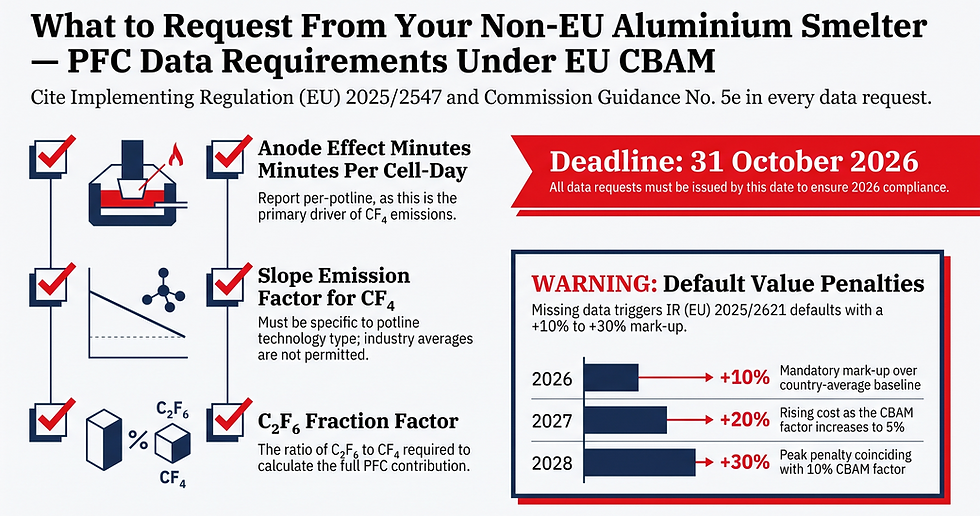
Aluminium is the only CBAM sector that mandates PFC reporting alongside CO₂. The two PFC gases arise during anode effect events — episodes when alumina concentration in the electrolytic bath drops below operating thresholds. Legacy potlines in older facilities, particularly in China, Russia, and Gulf Cooperation Council countries, operate with substantially higher anode effect frequencies. The data collection task is specific: the smelter must provide the three items named above for each potline that produced goods imported into the EU, calculated per the IR 2025/2547 methodology, not from generic lifecycle assessment databases or ESG reports.
3.4 Third-Party Verification — Accreditation, Activity Groups, and the Verifier Shortage
FINDING: Articles 8 and 18 of Regulation (EU) 2023/956 require embedded emissions in actual-value declarations to be verified by a verifier accredited by a national accreditation body (NAB) under Commission Delegated Regulation (EU) 2025/2551; as of August 2026, zero verifiers hold CBAM accreditation, with the Commission expecting the first accredited verifiers around September 2026, and DR 2025/2551 Annex I establishing 12 distinct CBAM accreditation activity groups in which unwrought aluminium and aluminium products are separate groups from iron and steel.
SO WHAT: An aluminium importer without an appointed verifier holding the correct aluminium-specific accreditation activity group by Q1 2027 cannot use actual verified emissions data in the 30 September 2027 declaration and must rely entirely on default values carrying the escalating mark-up penalty — and candidate verifiers, particularly those already EU ETS-accredited under Regulation (EU) 2018/2067, will face immediate high demand across all six CBAM sectors simultaneously from the moment accreditation is granted.
NOW WHAT: By 30 September 2026, identify at least three candidate verifier bodies with active EU ETS accreditation who are pursuing CBAM NAB accreditation for the aluminium activity groups and make direct contact to register client interest before accreditation is granted.
Verification is mandatory only for actual-value declarations. Importers who rely entirely on Commission default values do not require a verifier — but default values carry an escalating mark-up that makes that approach financially corrosive from 2027 onwards. The verification obligation applies at the production installation level: each installation whose goods are imported must have its 2026 data verified individually. Commission Implementing Regulation (EU) 2025/2546 establishes the verification principles, including a 5% materiality threshold for total specific embedded emissions. An unsatisfactory verification opinion forces the importer onto default values for that installation.
4. Key Dates and Deadlines

Table 2: EU and UK CBAM Key Dates — Chronological
Date | Obligation | Regime | Consequence of Missing |
1 January 2026 | EU CBAM definitive regime enters force; only authorised declarants may import aluminium above 50-tonne threshold | EU | Goods cannot clear customs; €300–500/tCO₂e unauthorised importing penalty |
31 March 2026 | Authorised declarant application deadline for provisional import rights | EU | No provisional import rights for late applications |
14 August 2026 | Commission publishes Guidance Document No. 5e — aluminium sector guidance | EU | Operating without current Commission methodology interpretation |
1 September 2026 | CBAM verifier registration in CBAM Registry opens | EU | Verifiers cannot begin client engagement without Registry registration |
~September 2026 | First accredited CBAM verifiers expected from NABs | EU | No accredited verifier available to assess 2026 data |
30 September 2026 | Operational target: verifier identification and Guidance No. 5e distribution | EU | Verifier capacity market fills; aluminium-qualified verifier unavailable |
31 October 2026 | Target: issue PFC data requests to all non-EU smelters | EU | Entire 2026 year may fall back to default values with +10% mark-up |
31 December 2026 | Target: confirm monitoring plans, default value review, verifier appointment | EU | Inaccurate declaration data; no agreed audit timeline for 2026 |
1 January 2027 | UK CBAM enters force; importers above £50,000 threshold must comply | UK | UK CBAM obligations accrue from this date |
1 February 2027 | EU CBAM certificate sales open on central platform | EU | Cannot meet Q1 2027 quarterly holding requirement |
31 March 2027 | First quarterly holding deadline — 50% of cumulative 2027 embedded emissions | EU | Quarterly holding breach; NCA enforcement action |
30 June 2027 | Target: receive completed verification report for 2026 data | EU | Insufficient time to reconcile, top up certificates and prepare declaration |
30 September 2027 | First annual CBAM declaration and certificate surrender (covering 2026 imports) | EU | €100/tCO₂e shortfall penalty plus residual surrender obligation |
31 October 2027 | Certificate repurchase window closes (up to 50% of prior year purchases) | EU | Excess certificates cancelled 1 November without compensation |
31 May 2028 | UK CBAM first return and payment (covering 2027 imports) | UK | UK CBAM penalty for late or non-filing |
30 September 2026 is the window for verifier appointment. The verifier market begins at zero accreditation and faces simultaneous demand from all six CBAM sectors. A compliance manager who has not registered interest with candidate verifiers by this date risks being unable to appoint one with the correct aluminium-specific accreditation activity group before the 2026 data year closes.
1 February 2027 is the first date certificates can be purchased. The Q1 2027 quarterly holding calculation must be completed before this date using IR 2025/2621 default values. Missing this date means the 31 March 2027 quarterly holding deadline cannot be met, creating an NCA enforcement exposure before the first declaration is filed.
30 September 2027 is the primary compliance deadline of the entire report. The annual CBAM declaration covering all 2026 imports and the corresponding certificate surrender are both due on this date. A verification report must be in hand before the declaration can be filed. Both the declaration and the surrender are simultaneous obligations. Paying the shortfall penalty does not discharge the surrender obligation.
5. Financial Exposure and Risk
The financial obligation created by EU CBAM for aluminium importers in 2026 is approximately €2.82 per tonne net at Q2 2026 prices. The compliance infrastructure costs — verifier fees, supplier data collection, monitoring plan development — are real and immediate. The certificate liability trajectory to 2030 is where the cost differential between early preparation and delayed action becomes material.
5.1 Certificate Price Mechanics — Quarterly Pricing in 2026, Weekly from 2027
FINDING: CBAM certificate prices in 2026 are set as the quarterly average of EU ETS auction clearing prices under Implementing Regulation (EU) 2025/2548; the Commission published the Q1 2026 price at €75.36/tCO₂ on 7 April 2026 and the Q2 2026 price at €75.28/tCO₂ in July 2026, with Q3 and Q4 2026 prices to follow, and from 2027 pricing shifts to weekly averages.
SO WHAT: An importer purchasing certificates in 2027 for 2026 imports pays at the Q1–Q4 2026 quarterly averages, not at the 2027 weekly spot price — the 2026 certificate cost is a deterministic figure, not a live market risk, once all four quarterly prices are published.
NOW WHAT: Track Q3 and Q4 2026 quarterly certificate prices when published, calculate the estimated full-year 2026 certificate obligation using confirmed Q1 and Q2 prices for known import volumes, and prepare the cash outflow requirement for certificate purchases beginning 1 February 2027.
The quarterly pricing mechanism for 2026 is a one-time feature of the first operative year. From 1 January 2027, CBAM certificate prices shift to weekly averages. The certificate holding requirement is expressed as a volume of certificates, not a euro amount, so weekly price movements affect acquisition cost but not the number of certificates required. Certificates cannot be purchased during 2026 itself — sales open on 1 February 2027. Budget models should treat the 2026 certificate obligation as a January–September 2027 cash outflow.
5.2 Gross vs Net Obligation — The 2026 Figure Most Compliance Managers Are Getting Wrong
FINDING: At the Q2 2026 certificate price of €75.28/tCO₂ and a primary aluminium direct emission intensity of approximately 1.5 tCO₂e/t, the gross CBAM certificate obligation is approximately €112.92 per tonne — but the net 2026 obligation, after applying the 2.5% CBAM factor under the current free allocation phase-out schedule, is approximately €2.82 per tonne of primary aluminium imported.
Data verification note: The 2026 CBAM factor of 2.5% and the full phase-out schedule referenced in Table 3 are sourced from secondary research data and should be verified against Implementing Regulation (EU) 2025/2620 (SEFA methodology) or DG TAXUD Guidance Document 4 (free allocation adjustment) before financial commitments are made. The same caveat applies to the 2027–2034 phase-out percentages — all are pending primary-source confirmation.
SO WHAT: Compliance managers who have presented the gross figure of €112.92/tonne to their CFO or board have overstated the 2026 liability by a factor of approximately 40 — the financial urgency of 2026 is operational, driven by verifier appointment and data collection requirements, not by an immediate balance-sheet obligation at the gross scale.
NOW WHAT: Recalculate all internal CBAM cost projections on the correct net basis before 31 October 2026, building two financial planning scenarios — Scenario A (current law, phase-out to 2034) and Scenario B (proposed phase-out to 2038, pending co-decision) — with clear legislative risk labelling on Scenario B.
Table 3: Gross vs Net CBAM Certificate Obligation — Primary Aluminium 2026–2034
Based on Q2 2026 certificate price of €75.28/tCO₂ and 1.5 tCO₂e/t direct emission benchmark. Figures illustrative at Q2 2026 prices; actual prices will vary by year. All CBAM factor percentages (2026–2034) are pending primary-source verification at IR (EU) 2025/2620 or DG TAXUD Guidance 4.
Year | CBAM Factor (current law) | Gross Obligation/tonne | Net Obligation/tonne |
2026 | 2.5% | ~€112.92 | ~€2.82 |
2027 | 5.0% | ~€112.92 | ~€5.65 |
2028 | 10.0% | ~€112.92 | ~€11.29 |
2029 | 22.5% | ~€112.92 | ~€25.41 |
2030 | 51.5% | ~€112.92 | ~€58.07 |
2034 | 100.0% | ~€112.92 | ~€112.92 |
The 2030 net figure — approximately €58.07 per tonne — represents a 20-fold increase from the 2026 net obligation on identical import volumes at identical ETS prices. Analyst consensus projects ETS prices higher in 2030 than in 2026, which would compound that increase. A supply-chain sourcing plan anchored to 2026 cost levels requires systematic revision before 2028.
5.3 Default Values vs Verified Data — The Escalating Mark-Up
FINDING: Default embedded emission values for aluminium are published in Implementing Regulation (EU) 2025/2621 and carry a mandatory mark-up of +10% over the country-average baseline in 2026, rising to +20% in 2027 and +30% from 2028 onwards, adding approximately €11.29/tonne gross to the certificate obligation compared with verified actual data at Q2 2026 prices.
SO WHAT: The net financial cost of default reliance in 2026 is approximately €0.29/tonne — modest in absolute terms — but the mark-up combined with the rising CBAM factor makes default-based compliance materially more expensive than verified actual data from 2028 onwards, tripling the per-tonne cost differential between 2026 and 2028.
NOW WHAT: Begin verified actual data collection for 2027 imports immediately, review any 2026 exposure calculations against the current Commission default value tables at EUR-Lex, and confirm the correct values are applied before 31 December 2026.
Table 4: Verified Actual Data vs Default Values — Cost Comparison, Primary Aluminium 2026–2028
Q2 2026 certificate price €75.28/tCO₂. CBAM factor percentages pending primary-source verification — see Section 5.2 note. Figures illustrative. Default SEE = 1.5 tCO₂e/t × applicable mark-up.
Year | Mark-up | Default SEE | Default gross/t | Actual gross/t | Net (default) | Net (actual) |
2026 | +10% | ~1.65 tCO₂e/t | ~€124.21 | ~€112.92 | ~€3.11 | ~€2.82 |
2027 | +20% | ~1.80 tCO₂e/t | ~€135.50 | ~€112.92 | ~€6.78 | ~€5.65 |
2028 | +30% | ~1.95 tCO₂e/t | ~€146.80 | ~€112.92 | ~€14.68 | ~€11.29 |
For an importer taking 2,000 tonnes of primary aluminium per year, the 2027 net differential of approximately €1.13/tonne represents approximately €2,260 in additional annual certificate cost versus verified data. By 2028 the same volume generates approximately €6,780 in additional cost. These figures exclude the higher ETS prices projected for the late 2020s by most analyst forecasts.
5.4 Penalty Framework — Article 26 and the Total Non-Compliance Cost
FINDING: Article 26(1) of Regulation (EU) 2023/956 as amended by Regulation (EU) 2025/2083 establishes a certificate shortfall penalty of €100 per tonne CO₂e not covered by surrendered certificates, inflation-indexed from the base year — and payment of the penalty does not discharge the surrender obligation — while importing without authorised declarant status triggers a separate penalty of €300–500 per tonne CO₂e, three to five times the standard rate.
SO WHAT: The combined non-compliance cost — shortfall penalty plus the certificates still owed — reaches approximately €175.28/tCO₂e at Q2 2026 prices, approximately 2.3 times the cost of compliant certificate surrender alone, and an importer who pays the penalty still faces the full certificate acquisition obligation.
NOW WHAT: Model the penalty scenario in the CBAM financial plan as a risk line, and any company facing a potential certificate shortfall must contact its NCA before 30 September 2027 to explore remediation options, as the penalty clock begins from that date.
The €100/tCO₂e rate applies to the volume of net certificates that should have been surrendered but were not. Total cost per uncovered tonne of CO₂e at Q2 2026 prices: €75.28 certificate cost plus €100 penalty equals €175.28 — approximately 133% above the compliant certificate cost alone. The €300–500/tCO₂e penalty for unauthorised importing applies per tonne of CO₂e embedded in imported goods, not per shipment.
6. Sector-Specific Impact Analysis
Aluminium is structurally distinct from every other sector covered by EU CBAM in three respects: it is the only sector mandating PFC reporting alongside CO₂; it has the largest discrepancy in any covered sector between the direct emissions that count under CBAM and the total carbon footprint of its most carbon-intensive production routes; and it has the sharpest within-sector liability divergence between primary and secondary production. These distinctions shape the compliance experience of EU aluminium importers in ways that cross-sector guidance cannot address.
6.1 Primary vs Secondary Aluminium — The 90% Liability Divergence
FINDING: Secondary aluminium produced from recycled scrap via the electric arc furnace route carries direct embedded emissions of approximately 0.05–0.10 tCO₂/t — more than 90% lower than primary aluminium’s approximately 1.5 tCO₂e/t — generating a gross certificate obligation at the Q2 2026 price of approximately €3.76–€7.53/tonne versus €112.92/tonne for primary.
SO WHAT: Importers with certified recycled content have a material and growing cost advantage as the free allocation phase-out accelerates, but the advantage depends entirely on classifying scrap correctly — only post-consumer scrap (from end-of-life products) is zero-rated for embedded emissions, while pre-consumer scrap (manufacturing offcuts) retains the upstream production process’s embedded emissions and is not zero-rated.
NOW WHAT: Document the recycled content split and the pre/post-consumer classification for every aluminium supply source before Q4 2026, and confirm suppliers can certify the scrap content split in a format that an accredited verifier can assess under Commission Delegated Regulation (EU) 2025/2551.
A supplier shift from primary to certified secondary content on 500 tonnes of annual imports reduces the gross certificate obligation from approximately €56,460 to approximately €1,880–€3,765 at Q2 2026 prices. Pre-consumer scrap — the trimmings and offcuts generated during aluminium fabrication — carries the embedded emissions of the smelter that produced the original ingot. Post-consumer scrap — aluminium recovered from end-of-life products — is zero-rated because no production emissions are attributable to the recovery process.
6.2 PFC Emissions — The Anode Effect Data Gap and Its Financial Consequence
FINDING: Aluminium is the only CBAM sector requiring perfluorocarbon (PFC) emissions alongside CO₂; under Annex IV of Regulation (EU) 2023/956 and Implementing Regulation (EU) 2025/2547, two PFCs must be quantified — CF₄ (GWP 6,630) and C₂F₆ (GWP 11,100) — with legacy smelters in China, Russia, and GCC countries adding 0.3–1.5 tCO₂e/t in PFC emissions above the direct CO₂ baseline due to higher anode effect frequencies.
SO WHAT: A smelter that has never measured anode effect minutes per cell-day cannot provide CBAM-compliant PFC data, forcing the importer onto IR 2025/2621 default values at the +10% mark-up in 2026 rising to +30% from 2028; conversely, a smelter with below-default PFC rates has a direct financial incentive to provide verified measurement data even in 2026, because the default may overstate its actual PFC emissions.
NOW WHAT: Require every non-EU smelter to provide by 31 October 2026: (1) anode effect minutes per cell-day by potline; (2) slope emission factor for CF₄ per potline technology type; and (3) C₂F₆ fraction factor — citing Commission Guidance No. 5e as the applicable Commission document.
Anode effect events occur when the alumina concentration in the electrolytic bath drops below the operating threshold. Modern cell-control systems detect and terminate anode effects rapidly. Legacy potlines in older facilities, particularly in China, Russia, and Gulf Cooperation Council countries, experience substantially higher anode effect frequencies. The compliance manager’s key question is not whether anode effects occur — they occur in every primary smelter — but whether the smelter records them in the format IR 2025/2547 requires. Without installation-level measurements, the verifier cannot confirm a PFC figure below the applicable default.
6.3 The Indirect Emissions Gap — Carbon Asymmetry and What It Means for Compliance
FINDING: Primary aluminium smelting consumes approximately 14–16 MWh of electricity per tonne of metal, with electricity-related indirect emissions representing approximately 10–13 tCO₂/t for coal-grid primary smelters — none of which enters the CBAM certificate calculation under Annex II of Regulation (EU) 2023/956.
SO WHAT: A coal-grid smelter and a Norwegian hydropower smelter carry virtually identical CBAM certificate obligations of approximately 1.5 tCO₂e/t direct despite a total carbon footprint difference of 12–14 tCO₂/t — this is a deliberate policy design, not a compliance gap, and the compliance manager’s obligation ends at the direct emissions boundary defined by Annex II.
NOW WHAT: Remove electricity-related indirect emissions from all aluminium CBAM declarations and supplier data requests before 30 September 2027; any monitoring plan or verifier brief incorporating electricity consumption into the aluminium CBAM calculation is non-compliant with Annex II of Regulation (EU) 2023/956.
Commission Guidance No. 5e confirms this boundary under the definitive regime. A supplier who provides electricity consumption data in the belief it is required for CBAM has provided data that must not appear in the declaration. The compliance manager’s responsibility is to ensure neither the data collection process nor the verifier brief creates ambiguity about the emissions boundary defined by Annex II.
6.4 Supply Origin and CBAM Exposure — Exempt and Non-Exempt Producing Countries
FINDING: India’s unwrought aluminium exports to the EU fell 41.7% between the year-to-date period ending January 2025 (18,653.8 tonnes) and the equivalent period ending January 2026 (10,874.72 tonnes); and as of August 2026, no third-country carbon pricing scheme has been formally recognised under Article 9 of Regulation (EU) 2023/956 — including Turkey’s domestic carbon price and India’s Carbon Credit Trading Scheme — with a draft implementing regulation naming the United Kingdom, China, and California as candidates published 13 May 2026 but not yet adopted.
SO WHAT: Compliance managers sourcing from India, China, Turkey, UAE, Russia, or Bahrain face full certificate obligations with no Article 9 relief currently available, and the 41.7% decline in Indian unwrought aluminium exports to the EU confirms that CBAM is already functioning as a competitive price signal reshaping supply chain economics.
NOW WHAT: Map all current aluminium supply sources against CBAM regime status before 31 December 2026 and, for non-exempt sources, begin collecting documentary evidence of any domestic carbon price paid — even without formal Article 9 recognition — to support a retrospective deduction claim once the Commission’s draft implementing regulation is adopted.
Table 6: Aluminium Supply Origin — EU CBAM Regime Status
Country / Region | CBAM Status | Basis | Article 9 Deduction? |
Norway | Exempt | EEA member (~€4.4bn annual EU trade) | N/A |
Iceland | Exempt | EEA member (~€2.1bn annual EU trade) | N/A |
Liechtenstein | Exempt | EEA member | N/A |
Switzerland | Exempt | Linked ETS arrangement | N/A |
China | Subject to CBAM | Non-exempt third country | No (as of August 2026) |
India | Subject to CBAM | Non-exempt third country | No — CCTS not recognised |
UAE / Bahrain | Subject to CBAM | Non-exempt third country | No (as of August 2026) |
Turkey | Subject to CBAM | Non-exempt third country | No — domestic price not yet recognised |
Russia | Subject to CBAM | Non-exempt third country | No (as of August 2026) |
South Korea | Subject to CBAM | Non-exempt third country | Candidate under Article 9 review |
Norway and Iceland together account for approximately €6.5 billion in annual EU-bound aluminium trade and are fully exempt as EEA members (figures from specialist secondary sources; verify against Eurostat Comext before publication). Supply origin mapping is the first step in any realistic CBAM exposure calculation.
7. Practical Action Framework
Table 5: Compliance Action Calendar — August 2026 to September 2027
Quarter | Key Actions | Responsible | Deadline |
Q3 2026 (Aug–Sep) | Confirm authorised declarant status; identify three candidate verifier bodies; download and distribute Guidance No. 5e | Compliance / Legal | 30 Sep 2026 |
Q4 2026 (Oct–Dec) | Issue formal PFC data requests to all non-EU smelters; confirm monitoring plan adequacy; review current default value tables; confirm verifier appointment and audit timeline | Compliance / Procurement | 31 Dec 2026 |
Q1 2027 (Jan–Mar) | Calculate Q1 2027 quarterly holding using 2027 default values (+20% mark-up); register on certificate platform; purchase first certificate tranche; confirm verifier audit schedule for 2026 data | Finance / Compliance | 31 Mar 2027 |
Q2–Q3 2027 (Apr–Sep) | Receive verification report; reconcile against quarterly purchases; top up certificates; file annual declaration; surrender certificates | Compliance / Finance | 30 Sep 2027 |
7.1 Q3 2026 (August–September 2026) — Authorised Declarant and Verifier Identification
FINDING: As of August 2026, zero CBAM verifiers hold accreditation under Commission Delegated Regulation (EU) 2025/2551, with the Commission expecting the first accredited verifiers around September 2026 and DR 2025/2551 Annex I establishing 12 distinct CBAM accreditation activity groups in which unwrought aluminium and aluminium products are separate activity groups from iron and steel.
SO WHAT: Verifier capacity begins at zero in September 2026 and faces immediate contest across all six CBAM sectors simultaneously — an aluminium compliance manager who has not registered client interest with candidate verifier bodies before accreditation is granted risks being unable to appoint a verifier with the correct aluminium-specific activity group in time for the 2026 data year.
NOW WHAT: Complete three actions before 30 September 2026: (1) confirm authorised declarant status with the NCA; (2) identify at least three candidate verifier bodies with active EU ETS accreditation under Regulation (EU) 2018/2067 who are pursuing CBAM NAB accreditation for the aluminium activity groups; and (3) download and distribute Commission Guidance No. 5e to the compliance function and relevant supplier contacts.
The EU ETS accreditation pathway is the most reliable indicator of likely CBAM verifier competence. Bodies already accredited for EU ETS purposes understand industrial emissions monitoring, have established audit procedures for production installations, and are explicitly recognised by DR 2025/2551 Annex I as having a qualifying background for CBAM accreditation scope. Contacting candidate verifiers before their CBAM accreditation is confirmed is the operationally correct timing. The 30 September 2026 target is an operational window, not a regulatory deadline — demand will exceed supply without announcement.
7.2 Q4 2026 (October–December 2026) — Monitoring Plans and Supplier Data Collection
FINDING: Implementing Regulation (EU) 2025/2547 specifies the definitive-period methodology for aluminium embedded emissions, requiring installation-level monitoring plans covering CO₂ from anode consumption, CF₄ anode effect monitoring (anode effect minutes per cell-day and slope emission factors by potline), and C₂F₆ fraction factors — a monitoring plan adequate for transitional-period quarterly reporting may not meet the definitive-regime standard for verification under Commission Implementing Regulation (EU) 2025/2546.
SO WHAT: A non-EU smelter that submitted generic quarterly transitional reports during 2023–2025 has not necessarily implemented the installation-level monitoring plan that a verifier under DR 2025/2551 will need to issue a satisfactory opinion on 2026 data — and a supplier that cannot reconstruct PFC monitoring data for Q1–Q4 2026 will force the importer onto default values with the mark-up applied for the entire 2026 declaration year.
NOW WHAT: By 31 December 2026: (1) issue formal data requests to all non-EU smelters citing IR 2025/2547 and Guidance No. 5e; (2) confirm each smelter has an adequate monitoring plan covering direct CO₂ and both PFC streams; (3) obtain preliminary 2026 emissions data for certificate cost modelling; and (4) confirm verifier appointment with an agreed audit timeline for 2026 data.
The monitoring plan review is a quality gate for 2026 data that is already accumulating. Smelters have been recording anode effect data since 1 January 2026. Whether that data is in the form the IR 2025/2547 methodology requires depends on the smelter’s process control infrastructure. Many installations will have it; some will not. Identifying the gap in Q4 2026 gives the compliance manager time to either obtain the data retrospectively from process control system logs, or quantify the default value exposure and plan accordingly.
7.3 Q1 2027 (January–March 2027) — Certificate Purchase Opens and First Quarterly Holding
FINDING: CBAM certificate sales on the central platform open 1 February 2027 under Regulation (EU) 2025/2083, and the quarterly holding requirement under Article 22(2) of Regulation (EU) 2023/956 as amended requires declarants to hold certificates equal to at least 50% of cumulative embedded emissions since the start of the calendar year at the end of each quarter, with the first holding deadline of 31 March 2027 requiring the holding calculation to use IR 2025/2621 default values.
SO WHAT: The Q1 2027 quarterly holding calculation must be completed before 1 February 2027 to allow certificate purchase before the 31 March deadline — for primary aluminium at the 2027 default value of approximately 1.80 tCO₂e/t (1.5 tCO₂e/t × 1.20 mark-up for the +20% 2027 schedule), an importer bringing in 500 tonnes in Q1 2027 must hold certificates covering approximately 450 tCO₂e by 31 March 2027.
NOW WHAT: By 31 January 2027: (1) calculate the Q1 2027 minimum certificate holding using the applicable 2027 default value; (2) register on the central certificate platform; (3) purchase the required certificate volume by 1 February 2027 at the earliest opportunity; and (4) confirm the verifier’s timeline for completing the 2026 data audit and delivering the verification report ahead of the September 2027 declaration.
The holding calculation formula is:
cumulative in-scope aluminium imports in tonnes (from the start of 2027 to 31 March 2027) × applicable IR 2025/2621 default specific embedded emission value × 50%.
For 2027, the applicable default value for primary aluminium uses the +20% mark-up — not the +10% applicable to 2026. Applying the 2026 mark-up to 2027 imports will produce an understated holding figure. The Q2 and Q3 2027 holding deadlines — 30 June 2027 and 30 September 2027 respectively — follow the same structure.
7.4 Q2–Q3 2027 (April–September 2027) — Declaration Preparation and Surrender
FINDING: The first annual CBAM declaration for calendar year 2026 imports and the corresponding certificate surrender are due by 30 September 2027 under Article 6 of Regulation (EU) 2023/956 as amended by Regulation (EU) 2025/2083; authorised declarants may repurchase from their NCA up to 50% of certificates purchased during the previous calendar year by 31 October 2027 at the original purchase price, with uncancelled excess cancelled on 1 November 2027 without compensation.
SO WHAT: The 30 September 2027 deadline requires a completed verification report, a completed annual declaration, and the correct certificate volume in the CBAM Registry account — all simultaneously — meaning a verifier overcommitted with other clients in Q2/Q3 2027 cannot deliver in time, and any compliance manager without an appointed verifier by Q1 2027 faces a material declaration-readiness risk.
NOW WHAT: By 30 June 2027: (1) receive the completed verification report from the appointed verifier for all 2026 imports; (2) reconcile verified total embedded emissions against Q1–Q4 2026 quarterly certificate purchases; and (3) purchase any top-up certificates required; then by 30 September 2027: (4) submit the annual CBAM declaration via the CBAM Registry; and (5) surrender certificates equal to total verified embedded emissions.
A compliance manager who receives the verification report in August 2027 has one month to reconcile, purchase top-up certificates if required, prepare the declaration, and file. Three months’ working time — if the report arrives by 30 June 2027 — is an adequate margin. The certificate repurchase window — 31 October 2027, 50% of prior-year purchases at original price — is a liquidity mechanism for importers who purchased more certificates than their verified emissions required. Certificates not repurchased by that date are cancelled on 1 November 2027 without compensation.
8. Strategic Outlook
Three forward-looking regulatory developments will reshape the scale, scope, and cost of aluminium CBAM compliance between now and 2030 — each requires a compliance manager to hold two planning scenarios simultaneously rather than plan on a single trajectory. Treating the 2026 net obligation as a stable baseline for multi-year decisions is the most common planning error this report can help correct.
8.1 Free Allocation Phase-Out — Current Law vs Proposed Schedule
FINDING: Under the current free allocation phase-out schedule, the CBAM factor for aluminium importers rises from 2.5% in 2026 to 10% in 2028 and 51.5% in 2030, reaching 100% in 2034; and the European Commission published a legislative proposal in July 2026 to slow this trajectory by reintroducing 15% of phased-out free allocation from 2028 and extending the phase-out end date, subject to European Parliament and Council co-decision.
Note: The specific reference number and exact parameters of this legislative proposal are sourced from secondary research data and should be verified at ec.europa.eu before publication. The phase-out percentages in this FINDING are also pending primary-source verification — see Section 5.2 note.
SO WHAT: Planning against the proposed schedule before it is enacted creates material financial exposure if the proposal fails — under current law, the 2028 CBAM factor doubles the 2027 obligation in a single year, meaning a certificate budget built on a softer 2028 trajectory will be materially understated if co-decision is delayed or the proposal is amended.
NOW WHAT: Build two financial planning scenarios — Scenario A (current law) and Scenario B (proposed schedule, pending co-decision) — with clear legislative risk labelling, present both to CFO and procurement, and revisit the scenario weighting when the proposal advances to second reading, expected no earlier than mid-2027.
Under current law, the 2028 CBAM factor is 10%, doubling from 5% in 2027. Under the proposal, the 2028 step would be moderated by the reintroduction of 15% free allocation. Compliance managers making multi-year sourcing decisions — including whether to shift from primary to secondary aluminium or from coal-grid to hydropower smelter origins — should model both scenarios before committing to structural supply changes, as those decisions carry multi-year financial consequences.
8.2 Downstream Expansion — The 2028 Proposal and Aluminium Supply Chain Reach
FINDING: COM(2025)989 proposes expanding CBAM scope from 1 January 2028 to approximately 180 downstream aluminium- and steel-intensive products, including fabricated metals, machinery, vehicle components, domestic appliances, and construction equipment, with embedded emissions for downstream goods attributed only to the precursor aluminium or steel content — not to fabrication or assembly; the proposal is in co-decision and is not yet enacted.
SO WHAT: Importers of aluminium-intensive downstream goods who do not currently identify as CBAM importers may be brought into scope from 2028 — and anti-circumvention provisions in the proposal specifically target pre-consumer scrap classification as a mechanism to artificially reduce embedded emissions.
NOW WHAT: Identify whether any goods in your current or projected import portfolio could fall within the 180 downstream categories and, if so, begin precursor aluminium content mapping to understand the eventual embedded emissions attribution before 1 January 2028.
The downstream expansion addresses carbon leakage at the fabricated goods level. COM(2025)989 targets this gap by bringing the precursor content’s embedded emissions into scope at the point of import of the finished good. For EU importers of downstream goods, this means a new compliance obligation will attach to categories they may not currently associate with CBAM, requiring supply chain mapping that goes upstream from the finished product to the aluminium input.
8.3 UK CBAM — A Parallel Compliance Track From January 2027
FINDING: UK CBAM, enacted as Part 5 of the Finance Act 2026 (Royal Assent 18 March 2026) and operationalised by S.I. 2026/802, 809, and 830 (in force 1 January 2027), applies to aluminium importers above the £50,000 rolling 12-month value threshold, with the first UK CBAM return and payment due 31 May 2028 and emissions calculation and verification rules remaining in draft as of August 2026.
SO WHAT: An importer active in both EU and UK aluminium markets faces two separate compliance tracks with different thresholds (50 tonnes annual mass for EU versus £50,000 annual value for UK), different timelines (30 September 2027 for EU versus 31 May 2028 for UK), different verification standards, and — until UK MRV rules are finalised — potentially different monitoring methodologies that may mean an EU CBAM verification report cannot be used directly for UK CBAM.
NOW WHAT: If you import aluminium into both markets, map the two compliance tracks in parallel; monitor HMRC’s forthcoming MRV guidance and default value publication; treat HMRC’s publication of UK MRV rules as the trigger event for activating UK-specific supplier data collection; and note that the UK HMRC registration portal opens by 1 January 2028 and the first return is due 31 May 2028.
ALFED Chief Executive Nadine Bloxsome stated in August 2026:
‘January 2027 is getting increasingly close, and there are still important questions around how the UK scheme will work in practice. Experience from the EU has shown just how challenging implementation can become when methodologies, systems and guidance are finalised too close to the point at which businesses are expected to comply. Our message to Government is therefore very straightforward: industry needs clarity, practical guidance and sufficient lead time.’
EU aluminium sector guidance was published on 14 August 2026 — less than five months before the 2026 definitive data year closed. UK emissions calculation and verification rules remain in draft. An aluminium importer operating in both markets navigates two regulatory frameworks with different documentary requirements simultaneously. The EU track is operationally more urgent; the UK track is legislatively less complete. Compliance managers whose EU CBAM programme is on track by Q1 2027 should immediately run the same scope and threshold analysis for UK CBAM, designating a named owner for UK monitoring preparedness before HMRC’s MRV guidance is published.
9. Frequently Asked Questions
What embedded emissions must I include in my EU CBAM aluminium declaration — and what must I leave out?
Declarations must include CO₂ from carbon anode combustion during Hall-Héroult electrolysis, CF₄ emissions with a global warming potential of 6,630 from anode effect events, and C₂F₆ emissions with a global warming potential of 11,100 from anode effect events. The direct emission benchmark for primary aluminium is approximately 1.5 tCO₂e/t. Electricity-related indirect emissions — representing approximately 10–13 tCO₂/t for a coal-grid smelter — are expressly excluded under Annex II of Regulation (EU) 2023/956 and must not appear in the declaration or supplier data requests.
Why are indirect electricity emissions excluded from EU CBAM for aluminium when they are included for cement?
Aluminium and steel are listed in Annex II of Regulation (EU) 2023/956, which restricts their CBAM obligation to direct emissions only. The Regulation’s design excludes the indirect electricity element for these sectors because the competitive distortion that CBAM addresses does not apply in the same way as for cement and fertilisers, whose producers do not receive equivalent indirect cost treatment under the EU ETS. Cement and fertiliser producers must therefore include indirect electricity emissions in their CBAM declarations; aluminium importers must not.
What is the actual net CBAM certificate cost for importing primary aluminium in 2026?
At the Q2 2026 certificate price of €75.28/tCO₂ and a direct emission intensity of approximately 1.5 tCO₂e/t, the gross obligation is approximately €112.92 per tonne. The net 2026 obligation — after applying the 2.5% CBAM factor — is approximately €2.82 per tonne. Note: the 2.5% CBAM factor is sourced from secondary research data and should be verified against Implementing Regulation (EU) 2025/2620 or DG TAXUD Guidance Document 4 before financial commitments are made. Under current law the net figure rises to approximately €5.65/tonne in 2027 and €11.29/tonne in 2028.
My smelter in China has never measured anode effect minutes or PFC emissions. What data do I need to request, and what happens if they cannot provide it?
Request three items, citing Implementing Regulation (EU) 2025/2547 and Commission Guidance No. 5e: (1) anode effect minutes per cell-day by potline; (2) slope emission factor for CF₄ by potline technology type; and (3) C₂F₆ fraction factor. If the smelter cannot provide this data, the importer must use default values from Implementing Regulation (EU) 2025/2621 for the PFC component, subject to the +10% mark-up in 2026 rising to +30% from 2028. For a legacy smelter with above-default PFC rates, the default may overstate actual emissions — making measurement financially beneficial even in the first compliance year.
What is the 30 September 2027 deadline, and what must I have completed before that date?
The 30 September 2027 deadline is the first annual CBAM declaration and certificate surrender deadline, covering all calendar year 2026 imports, under Article 6 of Regulation (EU) 2023/956 as amended by Regulation (EU) 2025/2083. Before that date, compliance managers must hold: a completed verification report from an accredited verifier covering all in-scope 2026 aluminium imports; sufficient CBAM certificates in the Registry account equal to total verified embedded emissions; and the submitted annual declaration. Certificate sales open on 1 February 2027, and the quarterly holding requirement of 50% applies at the end of each 2027 quarter.
The Commission has corrected CBAM default values for selected aluminium products. Do I need to recalculate my 2026 exposure?
The European Commission published a correction to CBAM default values for selected aluminium products in July 2026, applying retroactively from 1 January 2026. The main primary aluminium default values for CN 7601 unwrought aluminium were not materially changed by this correction. If your portfolio includes fabricated aluminium products in other in-scope Chapter 76 headings, retrieve the current Implementing Regulation (EU) 2025/2621 Annex at EUR-Lex and confirm you are using the most recent values for any 2026 exposure calculations completed before the correction was published. Note: the specific correction reference and scope are sourced from secondary research data and should be confirmed at EUR-Lex before publication.
10. References and Sources
Sources Used in This Report
EUR-Lex — Regulation (EU) 2023/956 (CBAM Regulation) — May 2023.URL: eur-lex.europa.eu/eli/reg/2023/956/oj/eng
EUR-Lex — Regulation (EU) 2025/2083 (Omnibus Simplification) — October 2025.URL: eur-lex.europa.eu/legal-content/EN/TXT/PDF/?uri=OJ%3AL_202502083
EUR-Lex — EUR-Lex CBAM Summary — Current.URL: eur-lex.europa.eu/EN/legal-content/summary/carbon-border-adjustment-mechanism.html
EUR-Lex — Delegated Regulation (EU) 2025/2551 (Verifier Accreditation) — 2025.URL: eur-lex.europa.eu/legal-content/EN/TXT/?uri=CELEX%3A32025R2551
European Commission — CBAM Definitive Regime portal page — January 2026.URL: taxation-customs.ec.europa.eu/carbon-border-adjustment-mechanism/cbam-definitive-regime_en
European Commission — CBAM Verification page — August 2026.URL: taxation-customs.ec.europa.eu/carbon-border-adjustment-mechanism/cbam-verification_en
European Commission — Guidance Document No. 5e — Aluminium sector guidance — 14 August 2026.URL: taxation-customs.ec.europa.eu/document/download/590e983b-c937-41ea-bb9f-810c29e70e1e_en
GOV.UK — Prepare for CBAM — HMRC guidance collection — July 2026.URL: gov.uk/government/collections/carbon-border-adjustment-mechanism
ICAP — EU adopts simplifications of CBAM rules — October 2025.URL: icapcarbonaction.com/en/news/eu-adopts-simplifications-cbam-rules-ahead-compliance-phase-starting-2026
SGS — CBAM Simplification Regulation Officially Adopted — November 2025.URL: sgs.com/en/news/2025/11/cbam-simplification-regulation-officially-adopted-by-the-eu
European Accreditation — The EU CBAM and the role of accreditation — March 2026.URL: european-accreditation.org/the-eu-cbam-and-the-role-of-accreditation/
KPMG UK — From draft to delivery: HMRC confirm the framework — July 2026.URL: kpmg.com/uk/en/insights/tax/tmd-from-draft-to-delivery-hmrc-confirm-the-framework.html
Saffery — UK CBAM compliance guide for importers — July 2026.URL: saffery.com/insights/articles/carbon-border-adjustment-mechanism/
DLA Piper — The UK's new carbon border tax — May 2026.URL: dlapiper.com/en-us/insights/blogs/environment-health-safety-and-product-compliance/2026/the-uks-new-carbon-border-tax-is-coming
CBAMReturn — UK CBAM: the complete guide for importers (2027) — July 2026.URL: cbamreturn.co.uk/guides/uk-cbam-guide
ALFED / CanTech International — ALFED calls for urgent UK CBAM clarity — August 2026.URL: cantechonline.com/news/43622/alfed-calls-for-urgent-uk-cbam-clarity-as-deadline-approaches/
Alcircle — CBAM hits Indian aluminium export by 41% — May 2026.URL: alcircle.com/news/cbam-hits-indian-aluminium-export-by-41-indian-carbon-credit-trading-scheme-to-reverse-the-slide-118416
Alcircle — EU CBAM after H1 2026 — aluminium trade premium analysis — August 2026.URL: alcircle.com/news/eu-cbam-after-h1-2026
Alcircle — NALCO CMD: Indian aluminium sector not prepared — January 2026.URL: alcircle.com/news/nalco-cmd-concerned-indian-aluminium-sector-not-prepared-for-a-green-shift-116970
cbamguide.com — CBAM Aluminium 2026: Direct Emissions, PFC Calculation — August 2026.URL: cbamguide.com/sectors/aluminium/
cbamguide.com — CBAM Calculation Guide 2026 — July 2026.URL: cbamguide.com/compliance/calculation/
cbamguide.com — CBAM Omnibus: 7 Key Changes from Regulation (EU) 2025/2083 — April 2026.URL: cbamguide.com/learn/omnibus/
Lexology (CMS) — CBAM implementation package and scope expansion — April 2026.URL: lexology.com/library/detail.aspx?g=ba1c1daa-b730-4fe8-a2cc-f28c9aa12137
Herbert Smith Freehills Kramer — Operationalisation and simplification of EU CBAM — January 2026.URL: hsfkramer.com/notes/energy/2026-posts/operationalisation-and-simplification-of-the-eu-cbam
greensutra.in — CBAM Explained 2026 — June 2026.URL: greensutra.in/news/cbam-explained-2026/
© 2026 Sekason Research Limited · cbamjournal.com · London, United Kingdom


